
Water Tank Replacement in London
Removal of a failed or condemned cold water storage tank, supply and installation of the replacement, then chlorination, sampling and certification before the new tank goes into service.
- GRP, plastic and sectional cold water storage tanks installed
- Old tank drained, broken down and removed from the space
- New tank chlorinated and sampled through a UKAS accredited laboratory
When does a water tank need replacing?
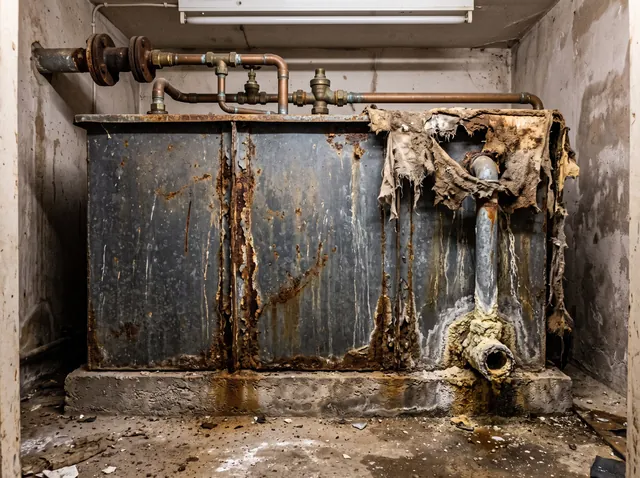
A cold water storage tank needs replacing when it can no longer be made watertight or hygienic. The usual triggers are corrosion, cracking or distortion of the tank body, a lid that no longer fits tightly, a tank that does not meet current specification, and water samples that keep coming back unsatisfactory after the tank has been cleaned and disinfected.
A dirty tank can be cleaned. A tank whose shell or lid seating has failed cannot, because the contamination route reopens the moment it refills. What points to replacement:
- Corrosion rust staining and pitting in older galvanised steel, which sheds particles and eventually perforates.
- Cracking or distortion stress cracks, weeping joints, or a tank bowed on an inadequate base.
- A lid that will not seal letting in light, dust, insects and warm air.
- Nothing to screen an open overflow with no sound surface to fit screens to.
- Repeat sample failures a tank that fails again after a full clean has a fault built in.
- Wrong size an oversized cistern turns over too slowly, so water stands and the residual decays.
Most are found at inspection, long before they become an emergency. See spring tank inspection and replacement.
Repair or replace: how the decision is made
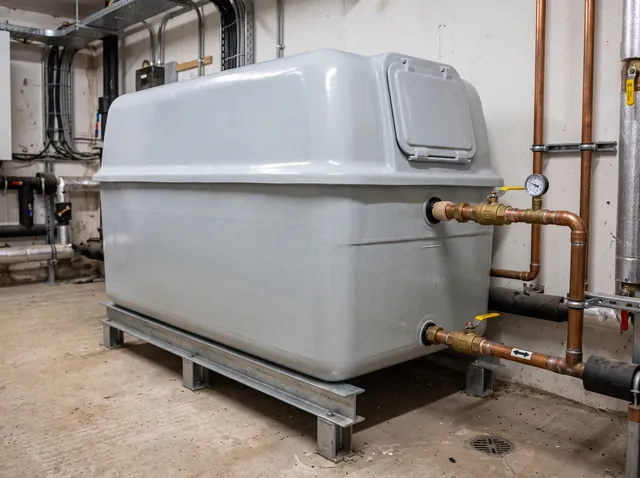
The decision is made at inspection, by separating faults in the fittings from faults in the tank. Lids, insect screens, insulation, ball valves, overflow and warning pipes can all be repaired or renewed on a sound tank. Once the tank body, its base or its connections have failed, repair stops being reliable and replacement is the honest answer.
An engineer opens the tank and records its condition item by item: lid and seating, screens on the vent, overflow and warning pipe, insulation, internal surfaces, sediment and corrosion, ball valve and water level, and stored water temperature. You get that record in writing either way.
Where the tank is sound and the problem is what has settled in it, the answer is a water tank cleaning visit, with the chemical stage covered under water tank disinfection. If you are unsure, start with an inspection from our water tank services.
Tank types we install
The right tank depends on the volume you need and the room there is to get it in.
| Tank type | What it is | Typically used for |
|---|---|---|
| GRP | Glass reinforced plastic, moulded in one piece, rigid and light for its size. | Small and medium volumes in plant rooms, roof spaces and larger lofts. |
| Plastic | Polyethylene and similar moulded cisterns with a close fitting lid. | Domestic lofts and small systems where a one piece tank fits. |
| Sectional | Bolted panels carried in as parts and assembled on site. | Large volumes, and anywhere a whole tank cannot be manoeuvred in. |
Sizing matters as much as material. A tank sized for a demand the building no longer has stores water longer than it should, which is the condition Legionella bacteria need.
The replacement process
From the first visit to the point the new tank is signed off and back in service.
- Survey and sizing the tank, the space, the route in and out, the pipework it serves and the demand of the building, then the type and capacity of the new tank.
- Planning the downtime the water is off while the tank is changed, so occupied buildings are booked early, late or at a weekend, with notice given.
- Isolation and removal supply isolated, cistern drained, then lifted out whole where access allows or cut down and taken out in pieces.
- Base and installation the base or bearers are made good so the tank is evenly supported, then it is set or assembled in place.
- Connection inlet, outlet, overflow and warning pipe connected, float valve set, vent and overflow screened against insects, tank lidded and insulated.
- Chlorination and commissioning tank and pipework disinfected, held for the required contact period, then flushed until the residual matches the incoming supply.
- Sampling and certification a sample is analysed by a UKAS accredited laboratory, and the certificate and commissioning paperwork are issued at handover.
A domestic loft tank is usually a single visit. A large sectional tank in a plant room is a planned job with a longer water off period, agreed before we start.
Access and location
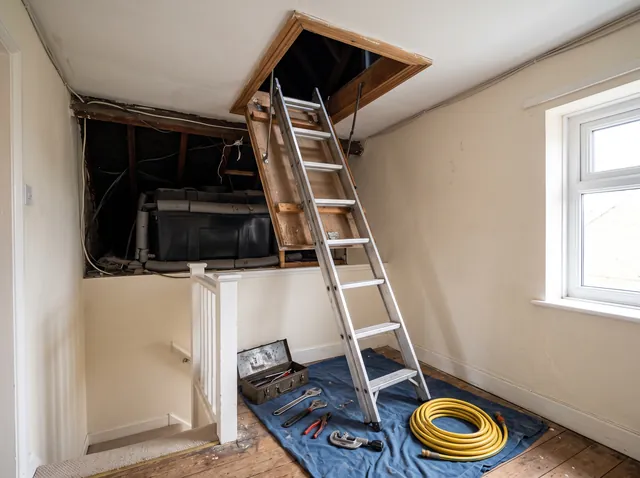
Access usually decides how the job is done, so it is surveyed first. Most tanks sit somewhere awkward: a loft reached through a small hatch, a plant room up several flights, or a tank room with a doorway narrower than the tank in it.
- Loft spaces the hatch dictates the tank. Where a moulded cistern of the right volume will not pass, the answer is a linked pair or a sectional tank.
- Plant and tank rooms the old tank often predates the finished room, so it is cut down to get it out and the new one assembled in place.
- Roof spaces access, lifting and safe working planned in advance, with materials carried up in sections and the route covered and cleared afterwards.
This is why sectional tanks exist. Only a panel has to fit through the door, so a large volume can go into a space a one piece tank could never reach.
Why a new tank is chlorinated before use
A new tank is not clean simply because it is new. It has been manufactured, stored, transported and handled, and the pipework connected to it has been cut, jointed and worked on. Disinfecting and flushing the installation, then proving it by sample, is how you know the water reaching outlets is fit to use.
Commissioning follows the same method as any system disinfection. The tank and its pipework are filled and dosed, held in contact for the required period, drawn through at every outlet so nothing is left untreated, then flushed until the residual matches the incoming supply. Only then is a sample taken. The full method is on our chlorination services in London page. If the building then stays empty for weeks, the water has stood and should be flushed and resampled before use.
What you receive
The paperwork proves the work was done and the water was safe afterwards.
- Installation and commissioning record the tank type and capacity, where it is and what it serves.
- Certificate of disinfection for the chlorination of the new tank and its pipework.
- Laboratory results analysis by a UKAS accredited laboratory. Legionella analysis takes longer than a general bacteriological result, because the organism has to be cultured first.
- Photographs before and after images where access allows.
- Remedial notes anything found elsewhere on the system that we did not put right on the day.
The duty holder must keep records of the precautions taken, so these belong with your Legionella risk assessment. A new tank changes the water system, and the assessment should be reviewed to reflect it.
Residential and commercial replacements
We replace tanks in single dwellings and in commercial buildings across London and the surrounding areas. In a house or flat that usually means one loft cistern, a morning without water and a tidy handover. In a block of flats, an office, a school or a care setting it means a planned job: the water off period agreed in advance, notice to occupants, out of hours work where supply cannot drop, and the certificate issued so the managing agent can close the action out.
-
London Water Treatment replaced our cold water storage tank as it didn't have a tight fitting lid and the tank showed signs of corrosion. The price was competitive and the engineers took great care in our property. Thank-you.
Sandra Wilson Private Home owner
Arrange a replacement quote
Tell us the property type, where the tank sits, roughly what it holds and how it is reached, and we will tell you what the job involves. You can request a replacement quote online or call us direct.