
Spring Water Tank Cleaning in London: Why April Matters
Water hygiene work follows the calendar more closely than most building owners expect. For cold water storage tanks in London, spring is the window that matters, because it is the point at which the weather stops keeping your tank cold for you. Here is why April is the month to act, what a professional clean involves, and who should be booking one now.
Why does timing matter for water tank safety?
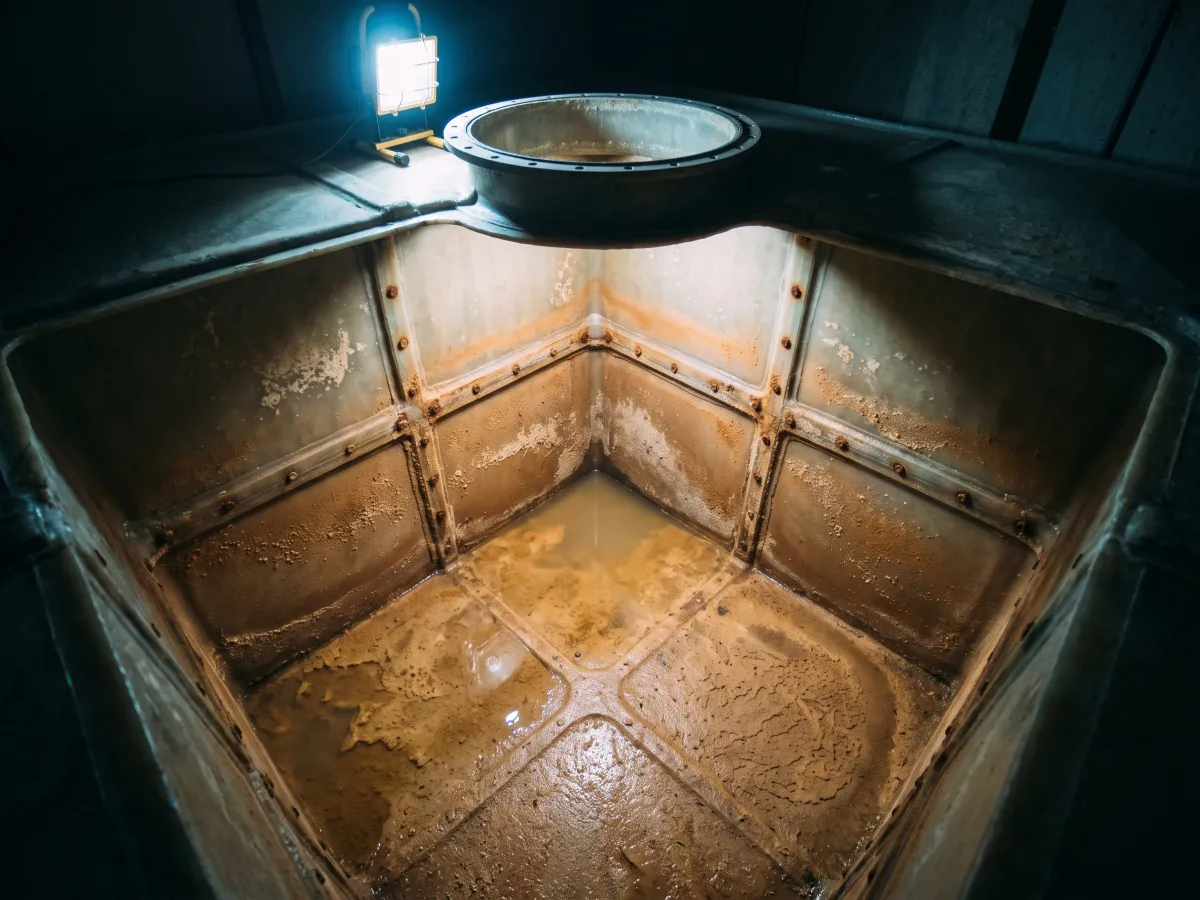
Cold water storage should be kept below 20C. Through winter, cold roof spaces and unheated plant rooms hold tanks in that range without any help. As ambient temperatures climb through spring, that free cooling disappears and stored water drifts up towards 20 to 45C, the range in which Legionella bacteria multiply.
Legionella bacteria are present at low levels in most water systems and, in that state, they are not a meaningful risk. What turns a background presence into a hazard is a combination of conditions: water at the wrong temperature, sediment and biofilm providing nutrients, water standing still rather than turning over, and a means of creating breathable droplets at an outlet. Temperature is the one condition that changes on its own, without anybody touching the system.
So a tank that measured comfortably cold in January can be sitting in the growth range by July with nothing having been altered. Uninsulated tanks in south facing roof voids, tanks in unventilated cupboards and tanks sharing a plant room with heating pipework all warm faster than the outside air. Tanks oversized for the building's actual demand warm faster still, because the water stands longer before it is drawn off.
April sits at the start of that transition. A poorly fitting lid, a failing float valve, missing insulation or heavy sediment on the base of the tank are all straightforward pieces of work now. The same findings during a July heatwave arrive alongside elevated water temperatures and a fully occupied building.
- Below 20C The temperature cold stored water should be kept below
- 20 to 45C The range in which Legionella bacteria multiply
- ACOP L8 The Approved Code of Practice behind the duty to control the risk
What does a professional water tank clean involve?
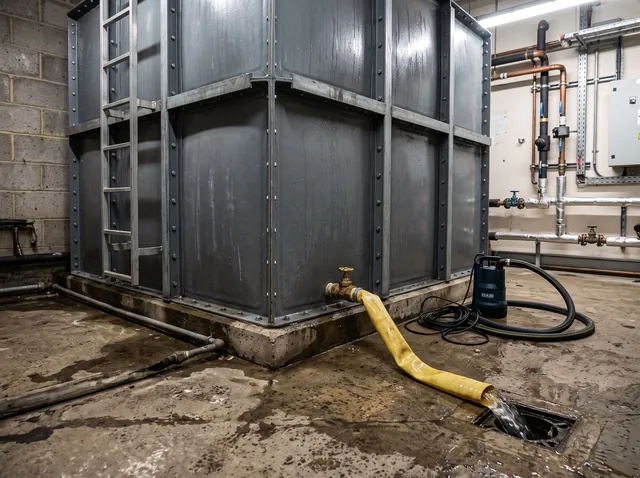
A professional clean is a sequence, not a drain and refill. The tank is isolated and emptied, the internal surfaces are physically cleaned of sediment, scale, debris and biofilm, a disinfectant is applied and held for its contact time, the tank is rinsed and refilled, and a sample goes to a UKAS accredited laboratory.
- Plan the visit Confirm tank size and construction, isolation points, and how the building manages while the water is off. On an occupied block that is usually what decides the date.
- Isolate and drain The tank is taken out of service and emptied, so the base, walls and fittings are all accessible.
- Clean the surfaces physically Sediment, scale, rust, insects, building debris and biofilm are removed by hand. This stage carries the job, because no disinfectant reliably penetrates thick sediment or an established biofilm.
- Inspect while it is empty The only point at which the internal surfaces can properly be seen, so the inspection happens here rather than as a separate visit.
- Disinfect and hold the contact time A disinfectant solution is applied to the internal surfaces and left to dwell for the required contact period. Concentration and contact time work as a pair.
- Rinse and refill The tank is rinsed thoroughly and refilled with fresh mains water, with the discharge handled safely.
- Sample and confirm Samples go to a UKAS accredited laboratory to confirm the disinfection was effective and the water meets the required standard.
- Report A written report covers the condition of the tank before and after, the disinfection carried out, the laboratory results and any remedial recommendations.
Because of the laboratory stage, confirmation follows the visit rather than arriving with it. If a result comes back unsatisfactory the system is re-treated and resampled, but a tank that fails more than once is usually telling you something structural: a lid that does not seal, missing insulation, or a tank so oversized for demand that the water never really moves.
Our water tank cleaning service covers residential and commercial properties across London and follows this full process as standard. The report and the laboratory result together form part of your building's water safety records, which is what turns the work into evidence of compliance rather than a job that was simply done.
What does the inspection look for?
The inspection is half the value of a spring visit, because it finds the problems that would otherwise surface in the middle of summer.
An inspection checks the lid and covers, the insect screens on the overflow and warning pipe, the internal surfaces for corrosion and cracking, the inlet and outlet arrangement, the float valve, and the surrounding environment including insulation, ventilation and anything nearby that could warm the stored water.
- Lid and covers Gaps, damage, warping and missing fittings that let dust, light, insects or vermin reach the stored water.
- Screens and vents Insect screens fitted and intact on the overflow, warning pipe and any vent, so the tank is not open to the loft.
- Internal surfaces Corrosion, cracking and failing coatings, which point towards replacement rather than cleaning.
- Sediment and scale How much has built up since the last visit, the most direct read on how the tank is performing.
- Inlet, outlet and float valve Whether water moves across the tank rather than sitting in a stagnant zone, and whether the valve holds level.
- Overflow and warning pipe Correctly sized, terminated and clear, so the tank behaves as intended if the valve fails.
- Insulation and ventilation The condition of the insulation and the temperature around the tank, which decide how it behaves in July.
- Turnover and demand Whether the tank is sized sensibly for what the building uses, or water is standing longer than it should.
Many findings can be dealt with at the same visit and the rest scheduled while there is still time in the year to complete them. That is the argument for a proactive spring visit rather than a reactive summer one. For the same detail applied ahead of a building closure, see our water tank inspection services.
Who should prioritise a spring clean?
Any building with a cold water storage tank that has not been professionally cleaned and inspected in the last twelve months should book one now. Beyond that baseline, priority goes to buildings with low winter occupancy, unresolved findings from the last inspection, and buildings about to see a rise in water demand.
- Nothing done in the last twelve months No recent inspection means no current picture of the tank, and no evidence if you are asked for it.
- Reduced winter occupancy Buildings empty or lightly used over the winter, where turnover through the tank was low and water stood for long periods.
- Open findings from last time Anything the previous inspection recorded but nobody actioned. In spring those items stop being paperwork and start being risk.
- Demand about to rise Offices bringing staff back, new tenancies starting, or any building moving from light to full use.
- A system that has changed New pipework, a change of use, or outlets added, removed or taken out of service.
- Portfolios and multiple sites Where several buildings need scheduling, spring is the point to plan the year rather than react to it.
Across a portfolio, reviewing the whole regime is usually more useful than booking another one off visit. Our page on water hygiene audits sets out what that review covers and how it feeds a planned schedule.
When is cleaning not the answer?
Cleaning is not the answer when the tank itself has failed. Significant corrosion, cracking, structural damage or a construction that no longer meets current specification cannot be cleaned out. In those cases the honest recommendation is replacement, and spring is a practical time to carry it out.
A tank at that point tends to announce itself during the inspection. Rust returning within months of the last clean, a liner or coating breaking down, distortion in a plastic tank that stops the lid seating, or a sectional tank leaking at the joints all say the problem is the vessel rather than what is inside it. Cleaning it buys a short reprieve, and the laboratory results usually reflect that.
Replacing before the summer peak means the new tank is installed, commissioned and sampled while demand and temperatures are still moderate. Our water tank replacement service covers the full sequence, from removing the existing tank through to installation, commissioning and certification. For everything we do on stored water systems, see our water tank services.
| Found in spring | Found in summer | |
|---|---|---|
| Water temperature | Still in or near the safer range while the work is planned. | Potentially already in the growth range while you wait. |
| Options available | Clean, repair or replace, with time to choose properly. | Whatever can be arranged quickly. |
| Disruption | Water off window planned around the building. | Water off window dictated by urgency. |
| Evidence position | Documented, planned maintenance. | A reactive response to a problem already present. |
Should you combine the clean with a risk assessment review?
If your Legionella risk assessment is out of date, or the system has changed since it was written, combining the review with the tank clean makes sense. It is one set of access arrangements, one visit to the plant room or roof space, and it covers two separate obligations at the same time.
The two answer different questions. The clean deals with the condition of the tank today. The assessment deals with whether your control scheme is still suitable for the building as it now operates. Under ACOP L8 the dutyholder, meaning the employer, the self employed person or whoever controls the premises in connection with work, must ensure a suitable and sufficient assessment is carried out, that precautions are implemented and monitored, and that records of them are kept. It also has to be reviewed when there is reason to believe it is no longer valid, for example after a change to the water system or a change in how the building is used.
There is no Act or set of regulations in Great Britain called the Legionella Regulations. The duty comes from general health and safety law, principally the Health and Safety at Work etc. Act 1974 and the Control of Substances Hazardous to Health Regulations 2002, with ACOP L8 setting out how to comply and HSG274 Part 2 giving the technical detail for hot and cold water systems. That is why nothing prescribes a fixed cleaning interval. What is required is an assessment that reflects your building, and action on what it finds.
An April visit therefore tends to produce more than a clean. The tank is open, the engineer is already in the plant room or roof space, and temperatures, turnover and the surrounding environment can all be recorded while there is time to act. If nobody has looked at your assessment since the building changed, start with Legionella risk assessments in London and schedule the two together.
Booking a water tank clean in London this spring
If you manage a commercial or residential property in London with a cold water storage tank, April is the right time to act. A clean and inspection now protects occupants through the warmer months, supports your ACOP L8 obligations, and leaves you with documented evidence that the system has been properly maintained rather than an assumption that it has.
It helps to know the property type, how many tanks there are and roughly what size, where they sit, when they were last cleaned or inspected, and whether anything flagged last time is still outstanding. If access has to be arranged with residents, a managing agent or a building manager, say so and we will plan the water off window around it.
London Water Treatment works across London and the surrounding areas from our base in Brentford, for residential and commercial properties alike. Call 020 4532 7773, or book a tank clean using the enquiry form.
Get the tank cleaned before the weather turns
Tell us the property type, the tanks involved and when the tank was last inspected, and we will tell you what the visit involves and how long it takes.