
Water Tank Cleaning in London
Commercial and domestic cold water storage tank cleaning and disinfection across London, from a single loft cistern to sectional tanks serving a whole building.
- Drain, clean, disinfect, flush, refill and sample in one visit
- Carried out in line with ACOP L8, HSG274 Part 2 and BS8558
- Post work samples analysed by a UKAS accredited laboratory
What is water tank cleaning?
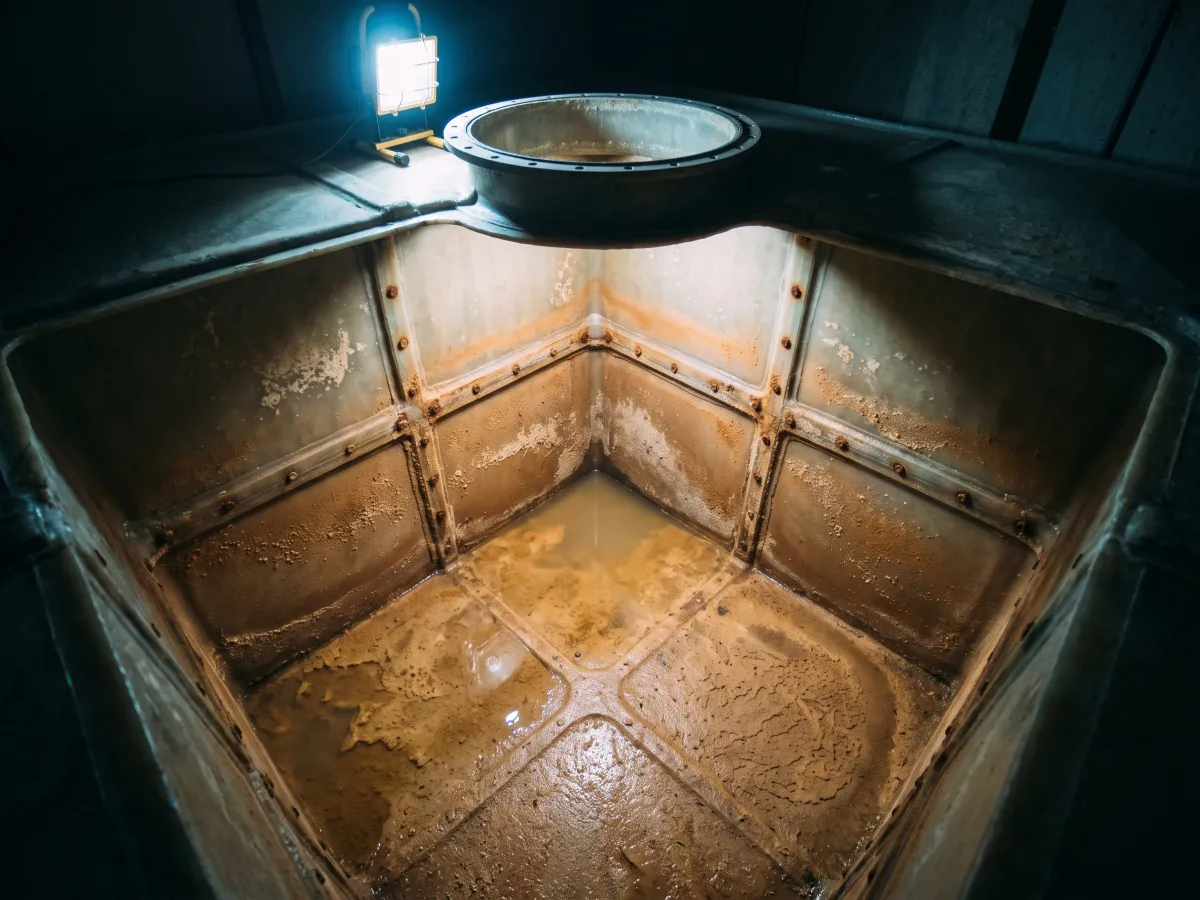
Water tank cleaning is the physical removal of sediment, scale, rust and biofilm from inside a water storage tank, followed by disinfection of the cleaned surfaces and the water. The tank is isolated, drained, cleaned by hand, dosed, flushed, refilled and sampled to prove it is fit for use.
The order matters. Scrubbing alone leaves live bacteria behind. Dosing alone leaves the debris that shields them. We clean plastic, GRP, sectional and older galvanised steel cisterns, as part of our wider water tank services.
Commercial water tank cleaning in London
The technical process is identical to a domestic clean. The difficulty is the isolation, the notice to occupiers, the working window, and the paperwork that has to satisfy a landlord, managing agent or enforcing officer.
- Offices roof plant rooms, often twin tanks so one side stays in service.
- Blocks of flats communal tanks feeding many dwellings, with resident notice to plan.
- Schools work scheduled into half term and holiday shutdowns.
- Care and healthcare higher risk occupants, so control is tighter.
- Hotels and industrial guest facing or restricted access, so out of hours work is usual.
Where a building cannot lose stored water in the day, the work runs at night or over a weekend so the supply is back before people arrive. Split tanks are done one side at a time. See also cold water storage tank cleaning in Brentford.
Do I have a cold water storage tank?
You have one if the building stores mains water rather than feeding every outlet straight off the incoming main. Look for a lidded cistern in a loft, roof space or plant room, with an overflow pipe running outside. In a house it usually feeds the bathroom and hot water cylinder.
Two clues settle it. If the kitchen cold tap runs colder than the bathroom taps, the kitchen is on the main and the rest is tank fed. A pipe stub through the eaves is the overflow.
Why does a water tank need cleaning?
Because stored water loses the disinfectant residual it arrived with, and material builds up inside the tank. Sediment, scale, corrosion and biofilm collect on the base and walls, giving bacteria shelter and nutrients. Warm, still, dirty water is what lets Legionella bacteria multiply, so removing the deposits removes the conditions.
- Sediment silt and grit from the main, settled on the tank floor.
- Scale hard deposits, common because much of London has hard water.
- Biofilm and corrosion a slime layer that shelters organisms, plus rust from older steel cisterns.
- Debris dust and insects that got past a poor lid or missing screen.
- Warmth water drifting above 20C in an unventilated loft or plant room.
Contaminated water harms people only when it becomes a breathable aerosol at a shower or spray tap. That is why tank condition, temperature and cleaning records appear in almost every Legionella risk assessments in London report we write.
What is the tank cleaning process?
- Survey tank type, size, location and access confirmed, and the working window agreed.
- Isolate and drain the inlet is closed and the tank drained down, or pumped out where there is no drain.
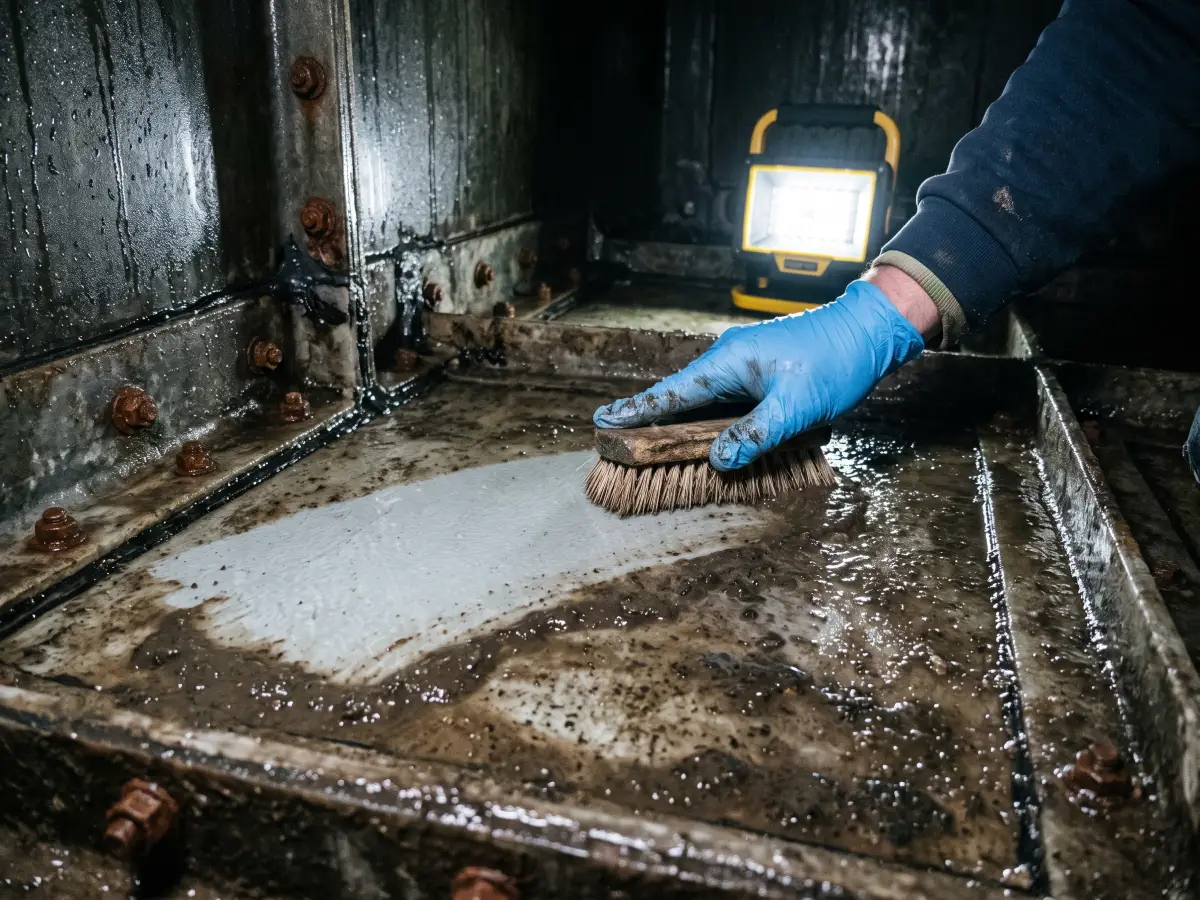
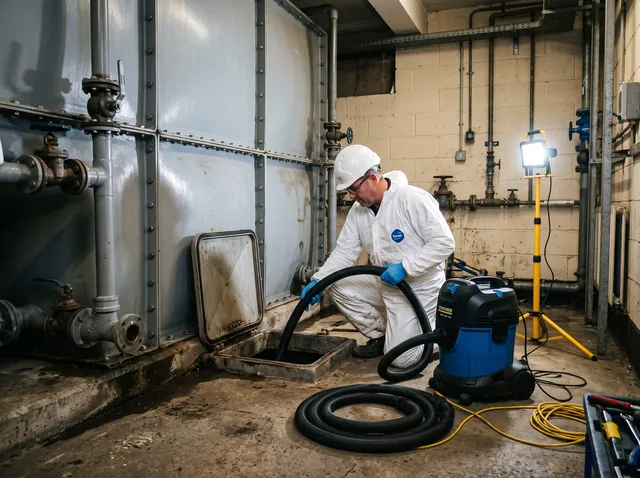
- Physical clean base and walls cleaned by hand, sludge removed by wet vacuum. This stage decides whether disinfection works.
- Inspect while empty lid, seals, insect screens, vent, insulation, ball valve and overflow checked and photographed.
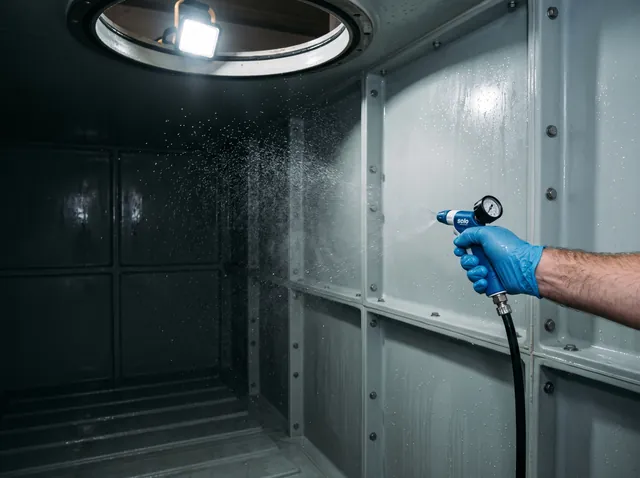
- Disinfect cleaned surfaces and refilled water dosed with chlorine to a set concentration.
- Contact period the dose is held for the required time and checked, because a decayed residual has not worked.
- Flush and refill flushed until free chlorine at the outlets matches the incoming supply, then returned to service.
- Sample post work samples go to a UKAS accredited laboratory.
- Report and certify you receive the report, the results and a certificate of disinfection.
What happens if a sample fails
An unsatisfactory result is part of the process, not the end of it. It can point to the tank, but equally to a dead leg, a little used outlet or a temperature problem. The cause is treated, the water resampled, and you get both records.
Cleaning and disinfection: what is the difference?
Cleaning is mechanical, disinfection is chemical. Cleaning physically removes sediment, scale and biofilm. Disinfection then treats the cleaned surfaces and the water with chlorine to destroy the bacteria that remain. A tank clean should always include disinfection, while disinfection is sometimes done alone, for example when commissioning a new tank.
Disinfection alone makes sense where there is nothing to scrub off: new pipework, a new tank, or a system opened up for repair. Where deposits are present the chemistry cannot reach through them, so the clean comes first. See water tank disinfection.
When should a water tank be cleaned?
Cold water storage tanks are commonly inspected once a year and cleaned when the inspection shows the tank needs it, rather than to a fixed calendar date. There is no single legal interval that applies to every tank. Your Legionella risk assessment sets the schedule for your building.
If sediment is negligible, the lid and screens are sound and temperatures are in range, a clean can wait. Some things move a tank up the list:
- A sample has come back unsatisfactory or Legionella positive.
- The building has been vacant or shut down, so water has stood.
- Work has been done on the tank, or the lid, screens or vent are damaged.
- Stored water is running warmer than the incoming mains.
- Occupiers report discolouration, taste or odour.
Spring is the most common time to book, because a tank goes into summer carrying whatever it gathered over winter. See spring water tank cleaning, and keep the intervals under review with regular water hygiene audits.
How long does it take to clean a water tank?
Most single tanks are cleaned, disinfected and back in service within a working day. A domestic loft cistern is often a few hours. A large sectional tank, or a pair of linked tanks cleaned one side at a time, can take longer. Laboratory results follow after the visit.
Timing is driven by the drain and refill, the deposit removed by hand, the contact time held and the flush. The last two cannot be rushed without invalidating the work, so expected downtime is confirmed at survey.
What we use to clean water tanks
Physical cleaning is done with clean brushes, cloths and a wet vacuum, using nothing that could taint the water. Disinfection uses a chlorine based disinfectant suitable for potable water, dosed to a measured free chlorine concentration, held for a set contact time, then flushed out before the tank returns to service.
The concentration and contact time come from the standard, not from habit. BS8558 and BS EN 806-4 set the disinfection regimes, and a common option for a cold water storage tank is 50 mg/l free chlorine held for one hour. Readings are taken on site and recorded. Legionella sampling follows BS 7592, and those results take around ten days because the organism has to be cultured.
What you receive afterwards
- Written report tank condition on arrival, the work carried out, and what was found inside.
- Photographs and readings before and after images, concentrations dosed, contact time held and flush down figures.
- Laboratory results the analysis certificate for every sample taken.
- Certificate of disinfection confirming the tank was cleaned and disinfected, with the date.
- Remedial recommendations anything not put right on the day, so it can be scheduled.
Keep it with your risk assessment and monitoring records. That is the file an enforcing officer, an insurer or an incoming managing agent will ask to see.
When cleaning is not enough
Some tanks cannot be cleaned back to a satisfactory condition, and it is more honest to say so at survey. The signs are consistent: heavy corrosion in galvanised steel, cracking or distortion in a plastic or GRP tank, a lid that cannot be sealed, and repeated sample failures after a competent clean.
Then the route is water tank replacement, and a new tank is chlorinated, flushed and sampled before commissioning. Most other faults are repairs. A perished lid seal, a missing insect screen or damaged insulation each let warmth, light or dirt into stored water.
Frequently asked questions
How long does it take to clean a water tank?
Most single tanks are cleaned, disinfected and back in service within a working day, and a small loft cistern is often a few hours. Large sectional tanks, or twin tanks cleaned one side at a time to keep the building supplied, take longer.
How often should commercial water tanks and cold water storage tanks be cleaned?
The usual pattern is an inspection once a year, with a clean carried out when the inspection shows it is needed. There is no fixed legal interval. Your Legionella risk assessment sets the schedule, and a failed sample or a shutdown can bring a clean forward.
What do you use to clean water tanks?
Clean brushes, cloths and a wet vacuum for the physical stage, with nothing used that could taint the water, then a chlorine based disinfectant suitable for potable water. The dose is measured, held for the contact time, then flushed out until free chlorine matches the incoming mains.
How much does water tank cleaning cost in London?
Cost depends on the tank rather than the postcode. The variables are the size and number of tanks, the access, how much deposit has to be removed, whether the work must run out of hours, and how many samples are needed. Give us those details for a firm quote.
Do we have to turn the water off while the tank is cleaned?
Usually yes, for most of the working period, because the tank has to be drained down. Where a tank is split into two compartments, one side is cleaned while the other stays in service. Otherwise the work is scheduled outside occupied hours.
Book a water tank clean in London
Tell us the property type, where the tank is and roughly what it holds, and we will tell you what the job involves and how long the water will be off. You can book a water tank clean online.