
Cold Water Storage Tank Cleaning in Brentford
Brentford is our base, so tank work in TW8 is close to home. We drain, clean, disinfect and inspect the tank, then hand over a report and a certificate of disinfection.
What does cold water storage tank cleaning involve?
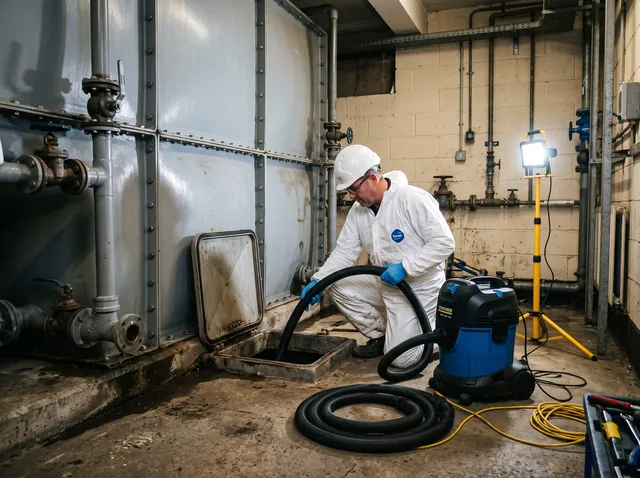
Cold water storage tank cleaning is a six stage job: survey and risk assessment, isolation and drainage, physical cleaning of every internal surface, disinfection held for a set contact time, rinse and refill with fresh mains water, then sampling and reporting. It ends in documentation, not just a clean tank.
The tank is the part of the system most often forgotten. It sits in a roof space or a plant room, it is rarely opened, and whatever collects inside it travels on to every outlet downstream.
It is the same discipline as our general water tank cleaning, applied to the cold water storage tank itself. For inspection, repair and replacement, see our water tank services.
- ACOP L8 HSE Approved Code of Practice on Legionella control
- BS8558 The standard behind our flushing and disinfection method
- UKAS Accredited laboratory analysis of post clean samples
Why do cold water storage tanks need cleaning?
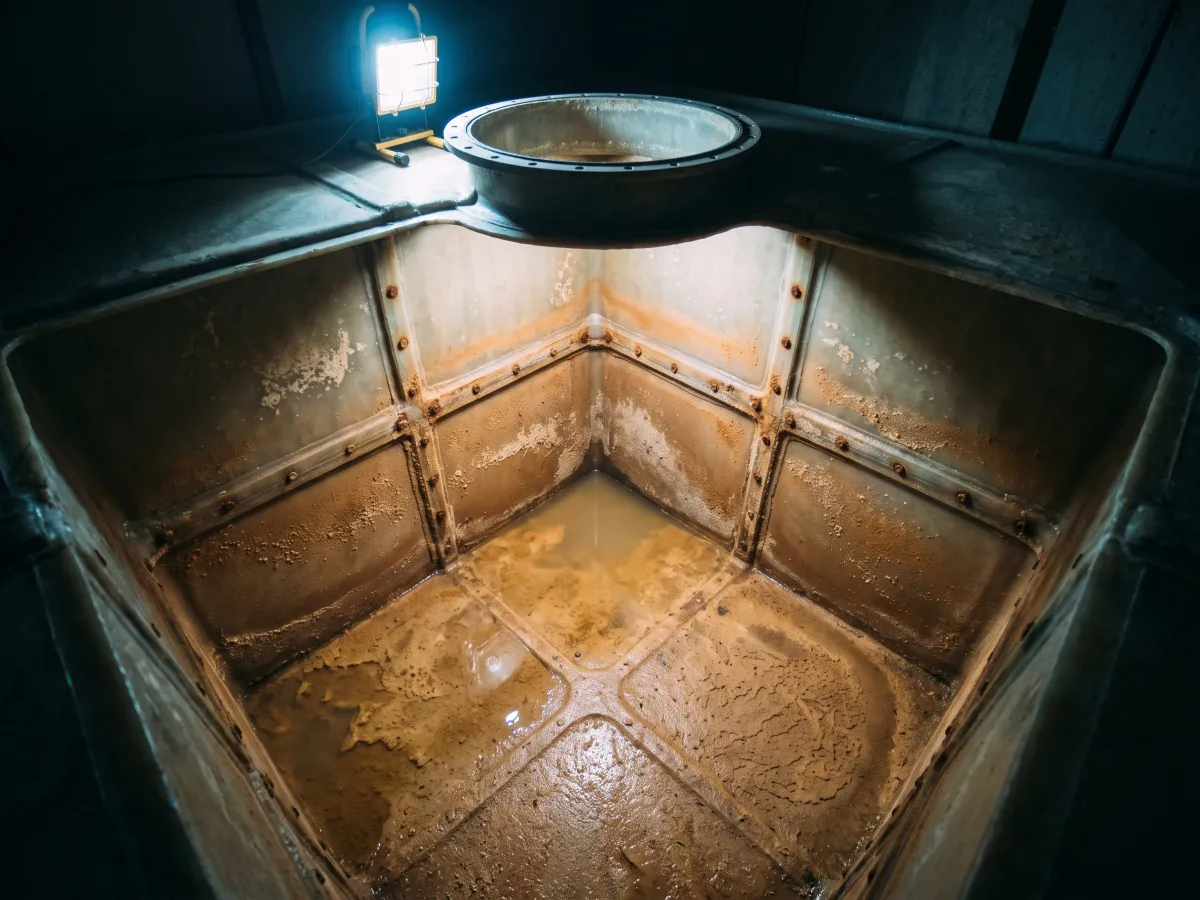
Stored water sits still, so a tank slowly collects sediment, scale, organic matter, rust and debris, and a film of bacteria on the internal surfaces. That biofilm shelters bacteria from disinfectant and gives Legionella the conditions it favours, which is why a tank has to be emptied and physically cleaned rather than only dosed.
Over time, a neglected tank accumulates:
- Sediment and scale
- Organic matter
- Bacterial growth
- Rust and debris
- Biofilm, which creates ideal conditions for Legionella
Neglected tanks also support Pseudomonas, coliform bacteria including E. coli, algae and corrosion by-products. Legionnaires' disease, a potentially fatal pneumonia, is contracted by inhaling airborne droplets containing Legionella, so this is not only a water quality problem.
The legal duty
According to the Health and Safety Executive, all duty holders have a legal obligation to control the risk of Legionella bacteria in water systems. The duty holder is whoever controls the premises in connection with work.
Frequency is set by the risk assessment, not by habit. If no assessment exists, start there. We carry out Legionella risk assessments in Brentford and can combine one with the tank visit.
Who needs cold water tank cleaning in Brentford and west London?
Any building that stores cold water before it reaches the taps. In Brentford that is mostly residential blocks and HMOs, offices and retail units, schools, healthcare and dental premises, hotels and leisure sites, industrial buildings and council property. If you are the landlord, facilities manager or building owner, the duty sits with you.
- Residential blocks and HMOs One communal tank feeding many homes.
- Offices and retail units Work run around trading hours.
- Schools and colleges Deep cleans timed to holidays.
- Healthcare and dental premises Vulnerable users, tighter documentation.
- Hotels, spas and leisure centres High turnover and intermittent outlets.
- Industrial sites and warehouses Large or oversized storage.
- Public and council buildings Cleaning recorded in a water safety regime.
- Care premises Where exposure carries the highest consequence.
Our step by step tank cleaning process
Six stages, the same on a loft tank and on a sectional tank in a plant room.
- Site survey and risk assessment We assess the tank's condition, volume, accessibility and usage, then tailor the method. Access usually decides how long the job takes.
- Isolation and drainage The tank is isolated from the system and drained safely, so nothing from it is carried into the distribution pipework.
- Physical cleaning Using food safe tools, we scrub the internal surfaces to remove sediment, scale and biofilm. Disinfectant will not work through sludge.
- Chlorination or disinfection The tank is dosed with an appropriate disinfectant, for example sodium hypochlorite, and held for the required contact time.
- Rinse and refill Flushed and refilled with fresh mains water until no chemical residue remains.
- Sampling and reporting Post clean samples can be taken to confirm cleanliness and bacterial control, and the visit is written up.
All works are logged and certified against ACOP L8 and BS8558. The same method sits behind our water tank disinfection service, and pipework beyond the tank can be treated on the same visit through our chlorination services in Brentford.
The standards behind the work
ACOP L8 is the HSE Approved Code of Practice on controlling Legionella bacteria in water systems. It sets out what a reasonable regime looks like: a risk assessment, a named responsible person, tank inspection and cleaning, temperature monitoring, and records proving the controls were applied. It carries a special legal status, so if you did not follow it you must show you achieved the same outcome another way. HSG274 Part 2 gives the supporting technical guidance.
BS8558 covers the design, installation, testing and maintenance of services supplying water for domestic use within buildings. It is the document behind proper flushing, disinfectant dosing, microbiological sampling and commissioning before a system is handed back into use.
Between them, they are why a tank clean is a documented procedure rather than a wipe down. For the wider control regime, see our Legionella risk assessments in London.
Compliance reporting and certification
After a cold water tank clean in Brentford you receive a detailed post clean report, photographic evidence, water sampling results where sampling was carried out, a certificate of disinfection, and a compliance record you can put in front of an auditor, an inspector or an insurer.
- Post clean report What was found, what was done, what needs attention next.
- Photographic evidence Tank condition recorded before and after.
- Water sampling results Analysed by a UKAS accredited laboratory.
- Certificate of disinfection The document most people are actually asked for.
- Compliance record Filed evidence for audits, inspections and insurers.
Keep the pack together. Preparing for a health inspection, an Ofsted visit or an internal audit, the paperwork is what gives you traceability, and it is usually requested long after the engineer has left.
What we look at while we are there
An empty tank is the only sensible time to inspect it, so we do both in one visit.
- Lids, vents and overflows Whether the tank is sealed against insects, dust and light.
- Temperature Stored water that is warming up is a control failure in itself.
- Tank condition Photographed, including corrosion, distortion and liner damage.
- Remedial recommendations What needs doing next, and how urgent it is.
The point of the inspection is to say whether the tank will reach the next scheduled clean, and to give you actionable insight into the resilience of the water system.
When should a tank be replaced instead of cleaned?
When cleaning cannot restore it. A tank that is corroded through, distorted, leaking, made from a material that has broken down, or so oversized that the stored water stagnates between uses will not hold a clean result. In those cases replacement is the cheaper answer over the life of the building.
Access matters too. An old tank in a cramped loft with no proper lid may be impossible to bring up to standard, whereas a modern sectional or plastic tank can be sized and sealed correctly. We will say which side of the line yours falls on, and quote for water tank replacement where that is the right call.
Case studies: local success stories
-
Residential block in Brentford High Street
- Challenge: 2x 1,000L cold water tanks serving 40+ flats
- Solution: Overnight cleaning and chlorination, with full compliance certification
- Result: Passed Legionella audit, improved resident satisfaction
-
Academy school in TW8
- Challenge: Summer holiday deep clean of water storage tanks
- Solution: Full ACOP L8 compliant clean, microbiological sampling, remedial advice
- Result: No trace of Legionella detected, satisfied H&S compliance
-
Private dental practice
- Challenge: Client failed CQC water hygiene assessment
- Solution: Emergency tank clean and chlorination
- Result: Passed CQC reinspection, retained NHS contract
Frequently asked questions
How often should my cold water tank be cleaned?
The HSE recommends annual inspection, with cleaning at least every 12 months or as indicated by the risk assessment. The risk assessment is the deciding document. A tank in poor condition, in a warm plant room, or serving vulnerable users may need attention more often.
How long does tank cleaning take?
Typically 2 to 4 hours, depending on the size of the tank, how easy it is to reach and how contaminated it is. Twin tank installations take longer, and where a building cannot lose its supply during the day the work is done overnight.
Do you offer an out of hours service?
Yes. We provide evening and weekend slots so the work does not disrupt a business, a school day or residents. Tell us the window that suits the building when you enquire and we will confirm what can be scheduled before anything is booked.
Will my water be safe to use after cleaning?
Yes. The disinfectant is only in the tank during the contact period. Afterwards the system is flushed thoroughly with fresh mains water until no chemical residue remains, and we provide certification confirming water quality before the tank returns to normal service.
Can you also test my water for Legionella?
Yes. We take samples on site and have them analysed by a UKAS accredited laboratory, so the result will stand up in an audit. Because Legionella has to be cultured, results usually take around 7 to 10 days and are reported in colony forming units per litre.
Book a cold water tank clean in Brentford
We are based at Q West on the Great West Road and cover London and the surrounding areas, residential and commercial alike. Being local makes a short notice visit in TW8, or an overnight slot, easier to arrange.
Tell us the type of building, how many tanks and roughly what size, where they sit, whether the supply can be taken off during the day, and whether you need sampling as well. Call 020 4532 7773, or book a tank clean using the enquiry form.
Need a cold water storage tank cleaned in Brentford?
Tell us the building, the tank and when the water can be taken off, and we will tell you what is achievable.