
Legionella Risk Assessments in London
We assess, monitor and control Legionella risk in residential and commercial water systems across London, from a single let flat to a building with tanks, cylinders and hundreds of outlets.
- Assessments carried out in line with ACOP L8 and BS8558
- Same day Legionella risk assessments available across London
- Water samples analysed by a UKAS accredited laboratory

Do you need a Legionella risk assessment?
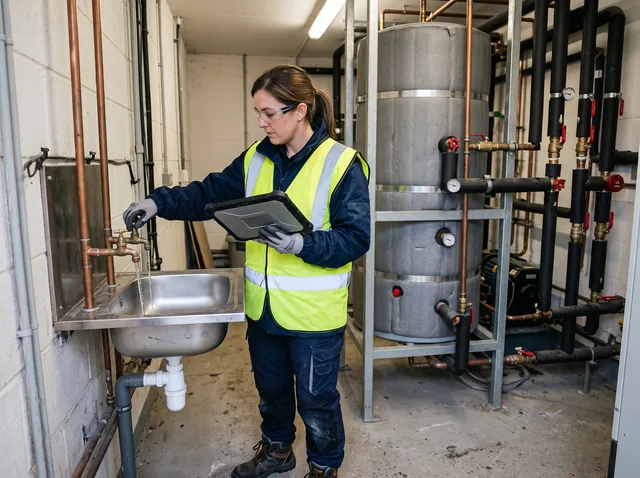
If you are an employer, a landlord letting domestic property, or a person in control of premises used in connection with a business, you need a Legionella risk assessment. It applies to almost every commercial building and every rented home in London, whatever the size of the water system.
Legionella becomes dangerous when it enters a man made system that lets it multiply, and that then turns the water into a spray someone breathes in. Growth is most likely between 20 and 45 degrees Celsius, in stored rather than moving water, and where sediment, scale or biofilm feed the bacteria. Loft tanks, communal cold water storage and rarely used outlets are all common in London property.
The assessment identifies whether those conditions exist on your system and what to do about them. Our guide explains what a Legionella risk assessment involves.
- ACOP L8 The HSE Approved Code of Practice our assessments follow
- HSG274 HSE technical guidance, Part 2 covers hot and cold water systems
- BS8558 The standard our disinfection work follows
Who has a legal duty to control Legionella
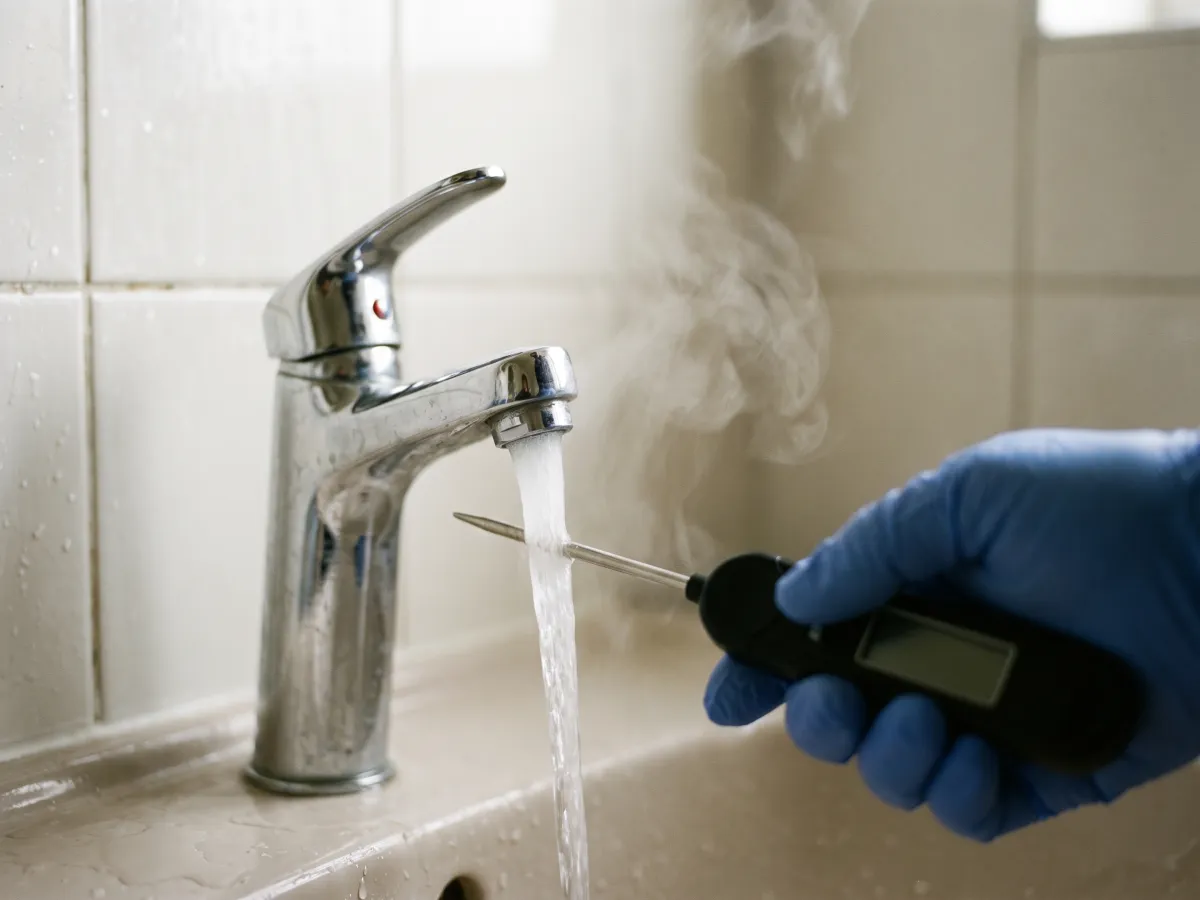
The duty holder must make sure a suitable and sufficient risk assessment is carried out. That is the employer where the risk is to employees or others, a self employed person, or whoever is in control of the premises, for example a landlord who keeps responsibility for maintenance.
There is no Legionella Act and no Legionella Regulations. The duty comes from general health and safety law: the Health and Safety at Work etc. Act 1974, the Control of Substances Hazardous to Health Regulations 2002 and the Management of Health and Safety at Work Regulations 1999. A section 3 duty cannot be passed on by contract.
What ACOP L8 actually is
The HSE publishes the Approved Code of Practice titled Legionnaires' disease: the control of legionella bacteria in water systems, known as ACOP L8. The current version is the fourth edition of 2013, and there is no fifth edition. It is not legislation, but it has, in the HSE's words, "a special legal status". If you are prosecuted having ignored it, you must prove you complied another way or the court will find you at fault. HSG274 Part 2 is the supporting technical guidance for hot and cold water systems.
The five employee threshold, explained properly
The often quoted figure of five employees does not decide whether you need an assessment. Every employer must assess the risk. That threshold relates to the written health and safety policy and the recording of significant findings. ACOP L8 separately requires the duty holder to make sure the assessor is competent. See your legal duties on Legionella and ACOP L8 compliance for building managers.
When a Legionella risk assessment is required
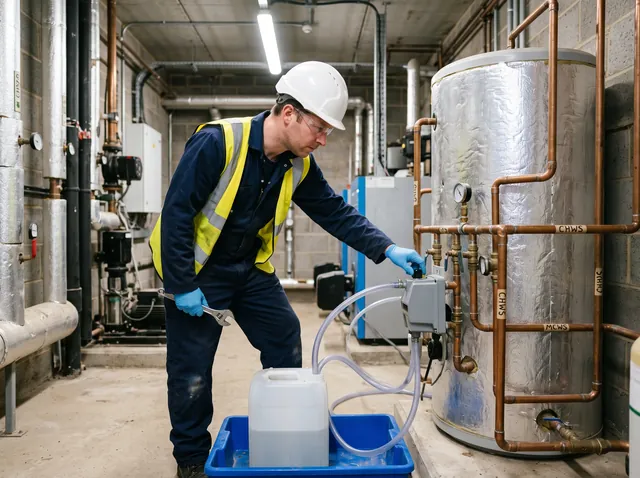
Every water system in a workplace or a let property needs an assessment, though not every system needs elaborate controls. The triggers below are the points at which an assessment is overdue, or the existing one has stopped describing reality and needs redoing.
- Vacant property After a building stands empty, cleaning, flushing and chlorination are often needed before the system is used again. See Legionella risk in vacant properties.
- Stored cold water A system with a storage tank carries more risk than one fed off the mains, because the water sits, warms and collects debris.
- Dead legs and redundant pipework Capped off branches left after a refurbishment hold water that never moves, a very common finding on commercial systems.
- Changes to the system New pipework, a new tank or a change of use or occupancy can all invalidate the previous assessment.
- Before reletting Landlords and agents should have a current assessment before a new tenant moves in, particularly after a void.
- Higher risk occupants Care homes, healthcare settings and schools warrant more frequent review, and warm weather lifts stored water above 20 degrees Celsius, so we cover summer Legionella risk separately.
What our Legionella risk assessment covers
The whole water system, how it is used, and who could be exposed.
- Cold water storage tanks: lid fit, screened overflow and warning pipes, insulation, sediment, corrosion and stored temperature
- Hot water cylinders and calorifiers, including storage temperature
- Distribution pipework, insulation, dead legs and redundant sections
- Outlets, taps, showers and any fitting that generates an aerosol
- Temperatures at sentinel and representative outlets
- Flow and usage patterns, including little used outlets
- The condition and maintenance history of the system
- Who uses the building and whether anyone is more vulnerable
- Existing control measures and records, and whether they are followed
Residential and commercial
A single let flat with no stored water is a short assessment. A block of flats, a school or a care home with tanks, cylinders and hundreds of outlets is a far bigger job. Both are assessed to the same standard.
What you receive
You receive a written report, the risks found categorised by level of concern, a prioritised list of recommended remedial actions and monitoring, and a certificate stating the level of risk identified. Together these are the documentation you use to demonstrate compliance with HSE guidance.
- The written report The system as found, the risks identified and the reasoning behind each finding, so a third party can follow it.
- Risk rating Each finding categorised, so you can see what needs attention now and what can be planned in.
- Prioritised recommendations The maintenance, remedial work or monitoring needed. On a low risk system it may confirm no further action is required.
- Certificate A certificate stating the level of risk, for your compliance file, managing agent, insurer or an enforcing authority.
- Advice on next steps We explain what any recommended work involves before you commit. For pricing, see how much a Legionella risk assessment costs.
The report alone does not discharge the duty. That is done by acting on the findings, keeping the records and reviewing the assessment.
How often should a Legionella risk assessment be reviewed?
Review it every two years as a baseline, and sooner for a higher risk system or after any significant change. ACOP L8 sets no fixed interval. The requirement is that the assessment is reviewed regularly and updated whenever there is reason to believe it is no longer valid.
Two years is a convention rather than a statutory deadline, and it is not a defence on its own. Bring the review forward if any of the following happen.
- Any change to the system, such as new pipework or a replaced tank
- A change in how the building is used or occupied
- An extended period of vacancy or reduced occupancy
- Control readings drifting out of range
- A sample result above the level your control scheme accepts
- Any suspected case of Legionnaires' disease linked to the property
Legionella testing and water sampling
Testing is the laboratory analysis of water samples to find out whether Legionella bacteria are actually present, and at what concentration. It is not automatically required in every building. Your risk assessment decides whether sampling is needed, from which points, and how often.
Where sampling is needed we provide a UKAS accredited Legionella sampling service, so the result will stand up in an audit or an investigation. Because the sample has to be cultured, results usually take around 7 to 10 days and are reported in colony forming units per litre. For the action levels and the full method, see Legionella testing and water sampling.
Legionella control and monitoring
The assessment identifies the risk. The control scheme keeps it managed.
- Temperature monitoring Hot, cold and stored temperatures checked at sentinel outlets on a set frequency, proving the system is held outside the range in which Legionella multiplies.
- Flushing regimes A documented routine for running little used outlets, the most useful control in a partly occupied building.
- Tank inspection Periodic inspection of tanks for sediment, corrosion, ingress and lid fit, with cleaning when it is due.
- Record keeping A log book holding the assessment, control scheme, monitoring and sample results and any remedial work.
- A named responsible person Someone with the authority and knowledge of the installation to make sure the scheme is carried out.
- Review of control measures Checking that what is written down is what is happening, and that it still works.
Near our base, see Legionella risk assessments in Brentford. Domestic landlords should read Legionella risk assessments for landlords.
Legionella disinfection and remedial work
Where an assessment or a sample result shows a system is not under control, disinfection brings it back. We chlorinate and disinfect pipework and water systems in accordance with BS8558, clean and disinfect cold water storage tanks, then resample to confirm the system is clear.
Remedial work is scoped from the findings rather than sold as a package. A typical job combines removing dead legs, cleaning and disinfecting the tank, chlorinating and flushing the pipework, descaling shower heads and correcting insulation. See our chlorination services in London for the dosing, dwell, neutralisation and certification method, and water tank cleaning where stored water is involved.
Simple control measures that reduce risk
Low cost measures that make a difference between assessments.
- Flush little used outlets Run every tap and shower not in regular use, long enough to draw fresh water through, and record it.
- Keep hot water hot Store hot water at 60 degrees Celsius so the vessel is not itself a growth environment.
- Keep cold water cold Hold cold water below 20 degrees Celsius, which usually means insulation and keeping pipework clear of heat sources.
- Fit tight lids to tanks A tight fitting, insulated lid with screened overflow and warning pipes keeps out light, warmth, dust and vermin.
- Descale shower heads Shower heads and hoses generate aerosol and collect scale. Clean them, and replace what cannot be cleaned.
- Remove what is not used Take out redundant pipework and disused outlets rather than capping them off and forgetting them.
Legionella guides and articles
Guidance from our team on assessments, testing, duties and seasonal risk.
- what a Legionella risk assessment involves
- how much a Legionella risk assessment costs
- Legionella testing and water sampling
- Legionella risk assessments for landlords
- your legal duties on Legionella
- Legionella risk assessments in Brentford
- ACOP L8 compliance for building managers
- summer Legionella risk
- Legionella risk in vacant properties
Frequently asked questions
Can you carry out an assessment at short notice?
Yes. We offer same day Legionella risk assessments across London for residential and commercial properties, with a full written report on completion. Call 020 4532 7773 and tell us the property type and whether there is a cold water storage tank.
Does a risk assessment always include water sampling?
No. Sampling is not automatic. The risk assessment decides whether it is needed, from which points and how often, based on the type of system and how reliably controls are held. Where it is required, laboratory results usually take around 7 to 10 days.
Do landlords letting a single flat need one?
Yes. HSE guidance is clear that landlords of domestic rental property have a duty to assess and manage Legionella risk, whether they let one flat or a large portfolio. The assessment for a simple domestic property is far less involved, but it is still required.
What happens if the assessment finds a high risk?
You act on the findings promptly. That usually means disinfection of the affected system, cleaning and disinfection of any cold water storage tank, chlorination and flushing of pipework in accordance with BS8558, resampling to confirm it is clear, and a review of the controls.
Book a Legionella risk assessment in London
Call the team, or book a Legionella risk assessment online and tell us the property type, the system and the date you need the report by.