
How Much Does a Legionella Risk Assessment Cost?
One of the first questions property and facilities managers ask is a simple one. The honest answer is that it depends on your water system, but the factors that drive the price are straightforward, and knowing them lets you budget properly and compare quotes fairly.
What does a Legionella risk assessment cost?
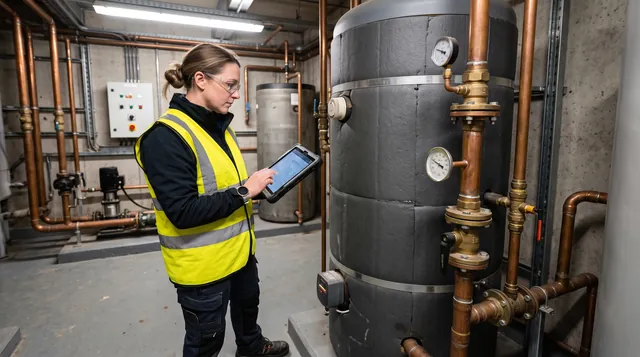
There is no flat rate. The cost of a Legionella risk assessment is driven by the size and complexity of the water system, not by a fixed fee. A small, simple, low risk premises sits at one end and a large multi outlet or multi site property at the other. Every assessment is priced against the system it covers.
An assessment is a physical survey, so the price tracks the time it takes to do properly. Someone has to walk the system, record every asset, work out how water moves through the building, identify where it can stagnate or sit at the wrong temperature, and write it up in a form you can act on. A building with one incoming main, a handful of outlets and no stored water is a short job. One with a cold water storage tank, calorifiers, risers and many infrequently used outlets is not. A figure quoted without any conversation about your system is therefore either a headline number that will be revised later, or the price of a smaller job than the one you need.
What affects the cost of a Legionella risk assessment?
Six things account for almost all of the variation between one quote and another.
- Size and complexity of the water system Complexity matters more than floor area. A compact building with a tank, a boosted set and two calorifiers can take longer to survey than a larger, simpler one.
- Number of outlets and assets Taps, showers, tanks, calorifiers, vessels and dead legs all need locating and recording. The asset register is built one item at a time.
- Type and use of the building A small office is quicker to assess than a care home, gym, school or multi let block. Where vulnerable people are present, the assessment goes further.
- Number of sites Portfolios are usually priced per site, often with a reduction at volume, because travel and reporting overheads fall across several properties.
- Whether water sampling is included Sampling and laboratory analysis are a separate cost from the survey, and should be priced openly rather than quietly left out.
- Accessibility and existing records Locked risers, tank rooms needing a ladder or a permit, and missing drawings all add time. A usable existing asset register makes a building cheaper to assess.
What should be included in the price?
A compliant assessment should include a full site survey, an asset register, a schematic or written description of the system, a risk rating for each area, and a written report setting out prioritised recommendations. Anything less than that is a walk round, not an assessment, and it will not stand up when someone asks to see it.
The report is the deliverable you are actually buying. It should tell you what you have, what is wrong with it, which problems matter most and what to do about each one. Recommendations that read as generic advice rather than instructions specific to your building are a sign the survey was thin. Asset labelling and a log book are sometimes included too.
The requirement comes from general health and safety law rather than a Legionella statute. ACOP L8, the HSE Approved Code of Practice, states that a suitable and sufficient assessment must be carried out to identify and assess the risk of exposure to legionella bacteria from work activities and water systems on the premises, and that the dutyholder is responsible for ensuring it is done. See what a Legionella risk assessment involves for more on the duty.
Is the cheapest assessment the best value?
Not always. An assessment only protects you if it is thorough and carried out to the standard set by ACOP L8 and the HSE technical guidance in HSG274. A cheap, box ticking assessment that misses assets or gives vague recommendations leaves you exposed both to the risk itself and to enforcement action.
ACOP L8 is widely misdescribed, so it is worth being precise. It is not legislation. It is an Approved Code of Practice supporting the Health and Safety at Work etc. Act 1974 and the Control of Substances Hazardous to Health Regulations 2002, and it has a special legal status: if you are prosecuted and it is proved you did not follow the relevant provisions, you have to show you complied with the law some other way, or a court will find you at fault.
Competence is the other reason price and value diverge. ACOP L8 is explicit that the dutyholder must ensure the person carrying out the assessment and advising on prevention and control is competent to do so. A cheap assessment from someone who is not competent does not discharge that duty, and buying it does not move the duty either. Under section 3 of the same Act, a legal duty cannot be passed on by means of a contract. You remain the dutyholder whatever the invoice says.
What to check when comparing quotes
Two quotes for the same building are often quotes for two different pieces of work.
- Is the price for a full survey of every asset, or a sample of them? Some quotes cover only the plant room and main outlets.
- Does it include an asset register and a schematic or written description of the system, or just a narrative report?
- Is each area given its own risk rating, and are the recommendations prioritised rather than listed flat?
- Is sampling included, excluded or optional, and if included, is the laboratory UKAS accredited?
- Who is doing the survey, and what makes them competent for a system like yours?
- What is the turnaround from site visit to report, and can the report be shared with an insurer or an inspector as issued?
- Are remedial works, monitoring and future reviews quoted separately, and if so, on what basis?
If one quote is materially cheaper than the others, the difference is usually in one of those seven lines rather than in the hourly rate. Ask which one.
Does the cost include testing?
Usually not. Water sampling and laboratory analysis are normally quoted separately from the risk assessment, because they are a separate piece of work with a laboratory cost attached. Whether you need sampling at all depends on your system, and in many cases the risk assessment is what determines the answer.
Sampling is commonly recommended where temperature control is not being achieved, where stored water is in poor condition, where the building serves vulnerable people, after remedial work or disinfection, and where a system has stood unused. Our guide to Legionella testing and water sampling sets out when it is genuinely called for.
Where sampling is quoted, check the analysis is carried out by a UKAS accredited laboratory. Results from an unaccredited laboratory can be questioned by an insurer, an auditor or an enforcing authority, which turns a saving into a repeat cost.
Reassessment versus a first assessment
Reviewing an existing assessment is usually less involved, and therefore less costly, than a first full assessment. The asset register and schematic already exist, so the work is checking what has changed, testing whether the control measures are still valid, and updating the record rather than building it from scratch.
An assessment is not a one off purchase with a fixed expiry date. It should be reviewed whenever there is reason to think it is no longer valid: changes to the water system or the way it is used, changes to occupancy, a case of Legionnaires' disease associated with the premises, or control measures that are not performing. Periods of low or no occupancy count as a change of use, which is why vacant floors and seasonal shutdowns often trigger a review. Where a review finds the system has been altered significantly, the survey element grows and the price moves back toward a first assessment.
Getting a quote in London
London Water Treatment carries out Legionella risk assessments in London for offices, care homes, schools, landlords, managing agents and commercial premises, with pricing based on your system rather than a menu. We cover London and the surrounding areas from our base in Brentford.
For a quote that will not move later, tell us the property type and use, whether there is a cold water storage tank or a calorifier, roughly how many outlets there are, how many sites are in scope, whether an existing assessment exists, and any access constraints such as locked plant rooms or permits. If you are letting residential property, Legionella risk assessments for landlords explains what is proportionate for a single let flat.
Call 020 4532 7773 to talk it through, or get a quote using the enquiry form.
Frequently asked questions
How often do you have to pay for a new risk assessment?
A Legionella risk assessment should be reviewed regularly and whenever your system or its use changes. In many cases the existing assessment is reviewed and updated rather than started from scratch, which is usually less costly than a first full assessment.
Does the cost include Legionella testing?
Not always. Sampling is often quoted separately, because it carries a laboratory cost of its own. Whether you need it depends on your system, and the risk assessment is often what determines the answer.
Want a price for your building?
Tell us the property, the water system and how many sites are in scope, and we will quote against what you actually have.