
Water Tank Services in London
Cleaning, disinfection, inspection, repair and full replacement of cold water storage tanks for residential and commercial buildings across London and the surrounding areas.
- Cleaning, disinfection, inspection, repairs and replacement in one place
- Work carried out in line with ACOP L8, HSG274 and BS8558
- Post work water sampling analysed by a UKAS accredited laboratory
Do you have a cold water storage tank?
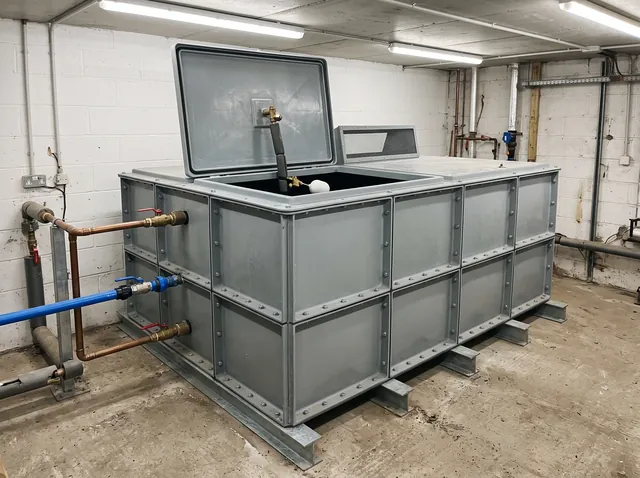
A cold water storage tank is a lidded cistern that holds mains water inside a building and feeds outlets, and often a hot water cylinder, by gravity. Most sit in a loft, a roof space or a plant room. If every tap in the building is not fed straight off the incoming main, you almost certainly have one.
In a house it is usually in the loft above the airing cupboard. In a block of flats, an office or a school it is more often in a roof level plant room, sometimes as a pair of linked tanks so one can be isolated for maintenance. The material affects how a tank ages:
- GRP glass reinforced plastic, moulded in one piece, common for medium sized tanks.
- Plastic polyethylene cisterns, typical in domestic lofts.
- Sectional bolted panels built on site, for large volumes and tight access.
- Galvanised steel older cisterns, prone to corrosion.
Our water tank services
Water tank cleaning and disinfection
Cleaning removes what has settled in the tank: sediment, scale, rust, biofilm and debris that got past the lid. Disinfection then treats the cleaned surfaces and the water, because debris shields bacteria from disinfectant. The tank is isolated, drained, cleaned by hand, dosed, held for the required contact period, flushed, refilled and sampled. Full detail is on our water tank cleaning page, and the chemical stage alone under water tank disinfection.
Water tank inspection
An inspection tells you what, if anything, needs doing. An engineer opens the tank and records the lid and its seal, the insect screens on the overflow and warning pipes, the vent, the insulation, the internal surfaces, sediment, corrosion, the ball valve and water level, and the stored water temperature. You receive a condition record, photographs where access allows, and a clear recommendation.
Water tank repairs
Many faults do not need a new tank. The common ones are a lid that no longer seals, missing or perished insect screens, damaged insulation, a ball valve holding the water level too high or too low, and badly arranged overflow and warning pipes. These let light, dust, insects and warmth into stored water, and are cheap to fix.
Water tank replacement
Where a tank is corroded, cracked, undersized or no longer meets current specification, replacement is the answer. We survey and size the new tank, remove the old one, install and connect the replacement, then chlorinate, flush and sample it before handover. GRP, plastic and sectional tanks are all installed, with sectional used where a one piece tank cannot be got into the space. See water tank replacement.
Why stored water needs managing
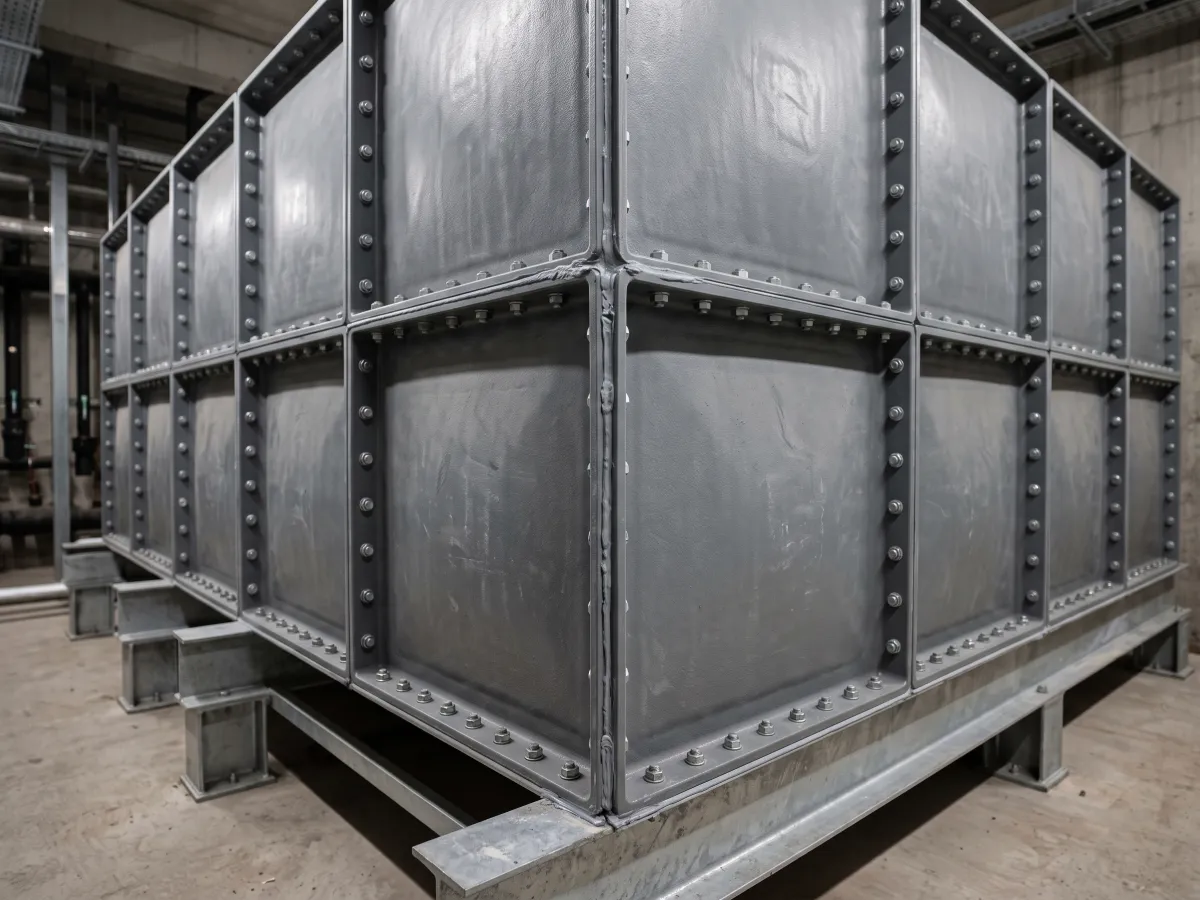
Water leaving the mains is treated and carries a disinfectant residual. The moment it is stored, that changes. Three things happen in a tank that do not happen in a live main.
- Temperature a tank in a warm loft or unventilated plant room lets stored water drift above 20C, the figure cold water should be kept under. Water warmer than the incoming mains points to a tank that is poorly sited, poorly insulated or oversized.
- Stagnation an oversized tank, or one in a lightly occupied building, turns its contents over slowly. The disinfectant residual decays and water stands long enough for bacteria to establish.
- Nutrients sediment, rust, scale and anything past a poor lid give bacteria something to feed on and shelter in, within the biofilm on the tank surfaces.
Warm, still, nutrient rich water lets Legionella bacteria multiply, and it becomes a risk when that water is turned into a breathable aerosol at a shower or spray tap and inhaled. Controlling the tank is one of the most effective things a duty holder can do, which is why tank condition and temperature appear in almost every Legionella risk assessments in London report we write.
- Below 20C Where stored cold water should sit
- ACOP L8 The HSE code our tank work follows
- UKAS Accreditation of our sampling laboratory
How often should a tank be inspected and cleaned?
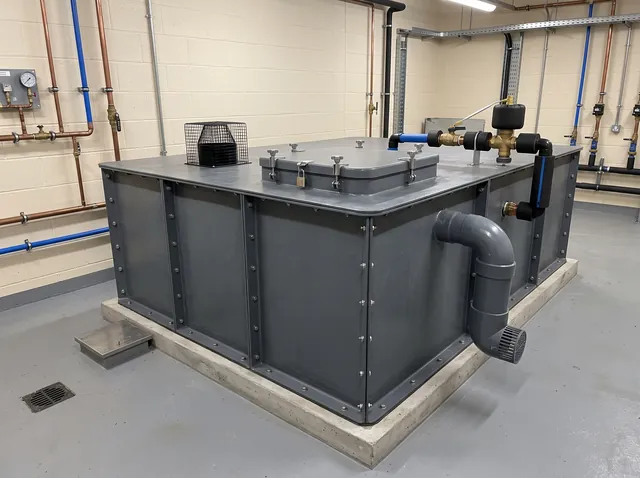
Cold water storage tanks are commonly inspected once a year, and cleaned when the inspection shows the tank needs it rather than to a fixed calendar date. There is no single legal interval that applies to every tank. Your Legionella risk assessment sets the schedule for your building, based on the system, its condition and how it is used.
The inspection turns a general rule into a decision about your tank. If the surfaces are clean, sediment is negligible, the lid and screens are sound and temperatures are in range, a clean can wait. If there is measurable sediment, biofilm, rust staining, insect debris or a temperature that has crept up, the tank is cleaned and disinfected.
Some situations move a tank up the schedule whenever it was last done:
- A water sample has come back unsatisfactory or positive.
- The building has been vacant or shut down, so water has stood.
- Work has been done on the tank or connected pipework.
- The lid, screens or vent are missing or damaged.
- A higher risk population uses the building, such as a care setting.
- A new tank needs commissioning before use.
Between visits the simple controls do most of the work: keep the lid tight and screens intact, keep the tank insulated, and flush little used outlets. Regular water hygiene audits are how most building managers keep that record straight.
Documentation you receive
The paperwork is the evidence that the work was done and the water was safe afterwards.
- Condition report what was found, item by item, with the recommendation and its priority.
- Photographs before and after images where access allows, which is what makes a report defensible later.
- Laboratory results analysis of the post work sample by a UKAS accredited laboratory. Legionella results take longer than a general bacteriological result, because the organism has to be grown before it can be counted.
- Certificate of disinfection issued where a tank has been cleaned and disinfected, or a new installation chlorinated and commissioned.
- Remedial actions anything we did not put right on the day, so it can be quoted, scheduled and closed out.
Keep it with your water safety records
Reports, results and certificates belong with your risk assessment and monitoring records. That is the file an enforcing officer, an insurer or an incoming managing agent will ask to see.
Tanks and your ACOP L8 obligations
There is no Act or set of regulations in Great Britain called the Legionella Regulations. The duty comes from general health and safety law, principally the Health and Safety at Work etc. Act 1974 and the Control of Substances Hazardous to Health Regulations 2002, supported by the Management of Health and Safety at Work Regulations 1999. Legionella bacteria are a biological agent, and so hazardous to health under COSHH.
The Health and Safety Executive explains how to meet those duties in the Approved Code of Practice known as ACOP L8, fourth edition, 2013, still current. An Approved Code of Practice is not legislation, but it carries a special legal status: if you are prosecuted and it is shown that you did not follow its relevant provisions, you must show you complied with the law some other way, or a court will find you at fault. The technical guidance sits alongside it in HSG274, and Part 2, covering hot and cold water systems, applies to cold water storage tanks.
In practice the duty holder, meaning the employer, the self employed person, or whoever controls the premises in connection with work, must arrange a suitable and sufficient risk assessment, appoint a competent person, put a written control scheme in place where needed, and keep records. A tank appears in that scheme four times: its condition, its temperature, the integrity of its lid, screens and vent, and the records proving it is inspected and cleaned. That starts with Legionella risk assessments in London, and where a result calls for disinfection it is handled through our chlorination services in London.
Water tank guides and articles
More detail on each service and the situations that trigger it.
Arrange a tank inspection or clean
Tell us the property type and where the tank is, and we will tell you what the job involves. You can arrange a tank inspection online or call us direct.