
Water Tank Inspection Services and the Christmas Shutdown
We inspect cold water storage tanks across London and the surrounding areas. A planned closure is the point at which stored water sits still for longest, so the weeks before a building shuts down are the right time to look inside the tank rather than the wrong time to find out.
What does a water tank inspection check?
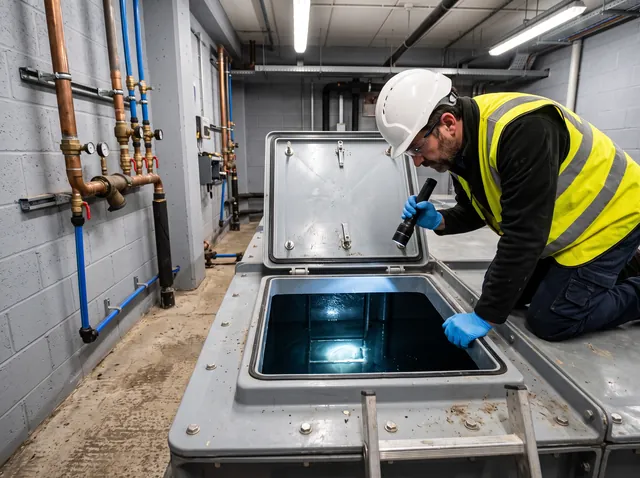
A water tank inspection is a documented check of a cold water storage tank and its fittings. It covers the lid and covers, insect screens, internal condition, corrosion, scale and sediment, insulation, stored water temperature, turnover, and the inlet, outlet, overflow and warning pipe. You receive a written record of what was found and what, if anything, the tank needs.
The inspection is deliberately physical. An engineer lifts the lid, looks at the water and the surfaces above and below the waterline, measures the temperature of the stored water rather than assuming it, and traces the pipework in and out of the tank. Most of what makes a tank a problem is visible in the first two minutes: a lid that does not seal, a screen missing from the overflow, a layer of silt on the base, or a tank warmed by a plant room that nobody thought of as a heat source.
- Lid and covers Close fitting, rigid, light excluding, and sealed at every pipe entry so nothing can drop or crawl in.
- Screens and vents Intact insect screens on the vent, the overflow and the warning pipe.
- Internal condition Sediment and debris on the base, scale on the walls, biofilm or slime on the surfaces, any sign of ingress.
- Structure Corrosion, distortion, bowed panels, cracked joints, weeping seams and the state of the base and supports.
- Temperature Stored cold water below 20°C, and whether anything nearby is warming the tank.
- Insulation Tank and associated pipework insulated, with the insulation intact and correctly fitted.
- Turnover and capacity Whether the stored volume is actually being used, or oversized for a building whose occupancy has changed.
- Fittings Ball valve operation, water level, inlet and outlet positions, and whether the tank is being drawn from in a way that moves the whole volume.
An inspection is not a clean. It tells you whether a clean is needed, and it gives you a dated record for the compliance file. Where the tank is due for work, we can carry it out ourselves, so the finding and the fix do not need two separate contractors. Inspections sit naturally alongside water hygiene audits, which look at how the whole system is being managed rather than at one asset.
What happens to water systems during a shutdown?
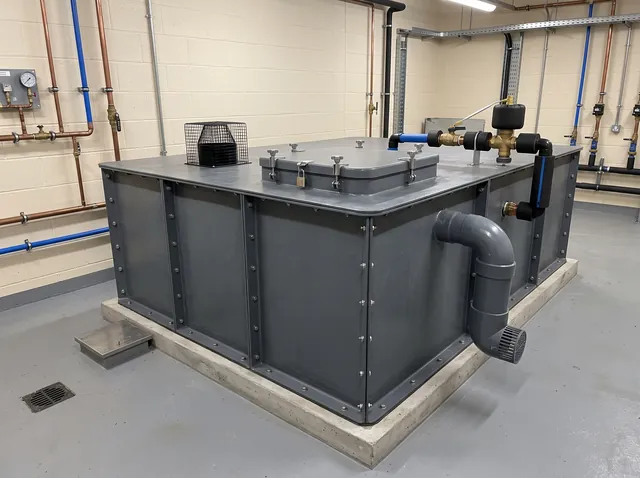
During a shutdown the flow stops. Water stands in the storage tank, in the pipework and in every dead leg and low use outlet. Without turnover, any disinfectant residual falls away and the temperature drifts towards the 20°C to 45°C range in which Legionella bacteria multiply. The longer the closure, the further that goes.
In a normal working week a commercial building flushes itself. Taps, toilets, kitchens and showers all pull water through the system several times a day, and that constant movement is one of the simplest defences a building has. When the offices go dark for Christmas, that movement stops everywhere at once.
The arithmetic is unforgiving. A building that closes on the 20th of December and reopens on the 2nd of January has over two weeks of standing water to account for. Heating left on a low setting makes it worse rather than better, because lukewarm is the least helpful state a system can be in: hot water at 60°C is hostile to Legionella, hot water sitting at 35°C is not. Meanwhile the nutrients that bacteria need, scale, sediment, rust and biofilm, are already present in most older systems and are undisturbed for the whole closure.
The same pattern applies to any extended vacancy, not only the festive period. If you manage empty residential stock or units between tenancies, our guide to Legionella risk in vacant properties covers the flushing and record keeping side in more detail.
Why cold water storage tanks need attention before a closure
Stored water is the largest single volume of standing water in the building, and usually the least visible.
Cold water storage tanks are common in commercial and older residential buildings across London. They sit in roof spaces, plant rooms and utility areas, which means that for most of the year they are genuinely out of sight and out of mind. Nobody walks past one. A tank can be missing half a lid for a year and nothing in the building tells you.
That matters more before a closure than at any other time, because the tank stops turning over. During normal occupancy a tank refills and empties continuously, and fresh mains water dilutes whatever is in there. Over a shutdown the same body of water sits at whatever temperature the roof space gives it, in contact with whatever sediment has settled on the base, feeding the pipework that everyone will drink from and shower in when they return.
If an inspection finds sediment, scale, a damaged lid or contamination, the answer is a clean and disinfection, and the sensible time to do it is before the building closes rather than in January when it is back in full use and every outlet is in demand. A clean and disinfection carried out in a quiet week is a straightforward job. The same work in the first week of term or the first week back in the office is a disruption. Full details are on our water tank cleaning page, and if the tank is beyond cleaning we also carry out repairs and replacement in GRP, plastic and sectional tanks.
Buildings on an annual cycle often pair the two seasonal jobs: a pre closure inspection in December and a spring water tank cleaning visit once the heating season ends and stored temperatures start to climb.
What is the risk of returning to a stagnant system?
The risk is that the first water used after a closure has been standing for weeks. Staff arrive, kettles are filled, taps run and showers are used, and all of that first use water passes through pipework nobody has flushed or checked. Exposure to Legionella comes from inhaling fine droplets, and reopening day creates plenty of them.
This is the part of the shutdown that gets least attention, because the building looks and feels normal. Nothing about a tap tells you the water behind it has not moved since before Christmas.
A pre return flush deals with most of it. Run every outlet, hot and cold, until the water reaches its normal running temperature, working from the outlet nearest the incoming main out to the furthest, and flush the toilets. Give the hot side long enough to actually pull hot water through rather than just empty the pipe. On showers, remove the head and flush the hose into the tray, or bag the head while it runs, so you are not filling a small room with aerosol from the water you trust least, and flush toilets with the lid down for the same reason. Record what was flushed, when, and by whom, because an undocumented flush is not evidence of anything.
For larger or more complex systems, or where the closure has been long, a professional flush and where necessary a disinfection is the more appropriate response. Our chlorination services in London cover commercial pipework, mains connections and storage tanks, with sampling and certification on completion, and we can attend buildings that need to reopen quickly after the festive period.
What to arrange before your building closes
Five things, all of which are easier to organise in November than to react to in January.
- Book the tank inspection Arrange one if the tank has not been checked recently, if the building has changed use, or if nobody can say when the lid was last lifted. Allow enough time for any clean the inspection recommends to happen before the closure.
- Review the risk assessment Commission a new assessment if there is none, if the existing one is more than twelve months old, or if the system has been altered since it was written. It is the document that tells you which outlets are low use and where the dead legs are, which is exactly what a shutdown exposes.
- Nominate someone for the closure Name the person responsible while the building is empty, tell them what is expected, and make sure they can get into the plant room. For longer closures that usually means a weekly flush of the outlets rather than leaving the system fully dormant.
- Plan the pre return flush Decide now who flushes what, and on which day, before occupancy resumes. Put it in writing and give it to whoever opens the building.
- Consider chlorination for larger systems Where the system is large, complex, or has stood unused for an extended period, a disinfection with sampling afterwards is more proportionate than a flush alone.
| Stage | What to do |
|---|---|
| Weeks before | Tank inspection, risk assessment review, and any clean, disinfection or repair the inspection identifies. |
| Closing day | Flush the system through, confirm hot water storage and cold water temperatures, and hand over the flushing plan to the nominated person. |
| During the closure | Flush outlets at the interval your risk assessment sets, commonly weekly for infrequently used outlets, and log every visit. |
| Before reopening | Full pre return flush of every outlet, hot and cold, with temperatures recorded. Disinfection and sampling where the system is large, complex or has been closed a long time. |
| After reopening | File the records with the risk assessment and note anything the closure revealed, so next year's plan starts from evidence. |
Taking these steps before you close is quick to arrange. Leaving them until January is a risk that is simply not worth taking, and it is the version that costs more.
Does ACOP L8 still apply during a shutdown?
Yes. The duty to control Legionella risk does not pause for a closure. It comes from the Health and Safety at Work etc. Act 1974 and the Control of Substances Hazardous to Health Regulations 2002, with the HSE Approved Code of Practice L8 setting out how to comply, and periods of low use are exactly the conditions the control scheme is meant to cover.
There is no single Legionella Act. L8 itself is not legislation either. It is an Approved Code of Practice, currently the fourth edition of 2013, and it has an unusual legal standing: follow it and you are doing enough to comply, depart from it and you have to show you complied some other way.
A suitable and sufficient assessment must be carried out to identify and assess the risk of exposure to legionella bacteria from work activities and water systems on the premises and any precautionary measures needed. The dutyholder is responsible for ensuring the risk assessment is carried out.
Approved Code of Practice L8, fourth edition, 2013
The dutyholder is the employer, the self employed person, or the person in control of the premises in connection with work. If you own, manage or occupy a commercial building, that is you, and an empty building is still premises under your control. A duty under section 3 of the 1974 Act cannot be passed on by contract, so instructing a managing agent does not move it.
L8 requires a written control scheme where the risk assessment identifies a need for one, and a review of the control measures. A control scheme that describes only normal occupancy is incomplete, because a planned shutdown changes the conditions the scheme was written for. The technical detail sits in HSG274 Part 2, the HSE guidance on hot and cold water systems, which is where the familiar figures come from: cold water below 20°C, hot water stored at 60°C and reaching 50°C at the outlet within one minute, and weekly flushing of infrequently used outlets. During a closure, every outlet in the building is an infrequently used outlet.
If your building has no current assessment, the weeks before a shutdown are a practical time to fix that. Our Legionella risk assessments in London cover commercial and residential properties, with same day assessments available where needed, and the findings are documented so the report goes straight into your compliance file.
Booking a water tank inspection
London Water Treatment inspects cold water storage tanks across London and the surrounding areas, from our base in Brentford, for commercial and residential properties of all sizes. Because we also clean, disinfect, repair and replace tanks, and carry out chlorination and Legionella work, an inspection that finds a problem does not leave you looking for a second contractor in the last week before you close. Our full range of water tank services covers cleaning, disinfection, inspection, repair and replacement in GRP, plastic and sectional tanks.
When you get in touch, tell us the property type, roughly where the tank is and how you get to it, when it was last inspected or cleaned if you know, and the dates the building will be closed. That is enough for us to tell you what the visit needs to include and to get it booked before the shutdown. Call 020 4532 7773 or book an inspection through the enquiry form.
Closing the building? Check the tank first.
Tell us your closure dates and where the tank is, and we will get the inspection in before the doors shut.