
Water Hygiene Audits and the Case for Regular Tank Cleaning
Getting a recurring maintenance line signed off is easier when you can explain exactly what the money buys. This page separates the water hygiene audit from the tank clean, sets out what each one produces, and gives you the safety, compliance and cost arguments for putting both on a schedule rather than calling them in when something has already gone wrong.
What is a water hygiene audit?
A water hygiene audit is a structured review of how a building's water systems are being managed. It looks at the assets, the written control scheme, the temperature and inspection records, and the gaps between what should be happening and what actually is. It reviews the management of the system rather than cleaning it.
The output is a picture of your position rather than a cleaner tank. An audit walks the system, confirms the asset register still matches what is installed, checks whether monitoring is being carried out and written down, and identifies where the paper trail stops. In many buildings the tanks are in reasonable condition and the failure is administrative: monitoring that lapsed when a facilities contract changed hands, an assessment written before an extension was added, or records held by three different people and never brought together.
That distinction matters if you are asked to justify the spend. An audit tells you which of your buildings need work and which do not, so the cleaning budget goes where it is needed instead of being spread evenly across a portfolio. For a wider view of the services an audit typically touches, see what water hygiene services cover.
Audit, clean or risk assessment: what is the difference?
They answer three different questions. A risk assessment identifies where Legionella risk sits in the system and what controls are needed. A clean physically removes what has built up inside a tank. An audit checks whether the controls the assessment called for are actually being carried out and recorded.
| Risk assessment | Hygiene audit | Tank clean | |
|---|---|---|---|
| Question it answers | Where is the risk and what controls are needed? | Are those controls happening and evidenced? | Is the tank itself clean and safe? |
| Main activity | Survey the system and assess the hazards. | Review assets, records, monitoring and gaps. | Drain, physically clean, disinfect, refill. |
| Typical output | A written assessment and a schedule of actions. | An audit report, updated asset register and action list. | A condition report and a laboratory sample result. |
| Triggered by | Having no current assessment, or the system changing. | A review point, a portfolio review or a handover. | An inspection finding, a failed sample or a schedule. |
The three work together. The assessment sets the regime, the audit tests whether the regime is being followed, and the cleaning and disinfection work is the regime being carried out. If your assessment is out of date or the building has changed since it was written, start with Legionella risk assessments in London and let the audit follow it.
Why does stored water degrade?
Stored water is the point in a building where water stops moving and starts warming. Sediment and silt settle on the base, organic matter and insects get in through gaps, corrosion deposits shed from the tank itself, and microbial biofilm forms on the internal surfaces. Each one feeds the next.
Biofilm is the part that makes the case for physical cleaning rather than dosing alone. Once it is established on a tank wall it shelters bacteria from disinfectant and consumes the chlorine before it reaches them, which is why a tank that is dosed but never scrubbed tends to produce a run of disappointing sample results. Sediment does the same job on the base of the tank. Warm water accelerates all of it, since cold stored water should be held below 20C and Legionella bacteria multiply in the 20 to 45C range.
None of this is dramatic on any given week. It is cumulative, which is exactly why it suits a schedule and resists being noticed until something forces an inspection.
- Below 20C The temperature cold stored water should be kept below
- 20 to 45C The range in which Legionella bacteria multiply
- ACOP L8 The Approved Code of Practice behind the duty to control the risk
The case for a regular schedule
Five arguments, in roughly the order a budget holder tends to find them persuasive.
Water quality and occupant safety
The most immediate benefit is water that is consistently cleaner. Routine cleaning removes sediment and silt, organic matter, corrosion and rust deposits and microbial biofilm, which lowers the risk of waterborne pathogens reaching the people using the building. In residential blocks, schools, care settings and healthcare properties that is the whole point of the exercise, and it is the argument that carries weight when nothing else does.
Legionella risk reduction
Legionella bacteria thrive in water that is standing still, warm and nutrient rich, and Legionnaires' disease is a potentially fatal pneumonia. A regular audit and clean cycle manages that risk by finding dead legs and poorly insulated tanks, confirming the correct temperatures are being achieved rather than assumed, recommending disinfection and flushing at the point they are needed, and keeping the compliance and action logs that show it all happened. Where a clean alone is not enough, water tank disinfection is the second stage.
Legal and regulatory compliance
Neglected water systems can put a building in breach of duties under the Health and Safety at Work etc. Act 1974 and the Control of Substances Hazardous to Health Regulations 2002, with ACOP L8 setting out how to comply and HSG274 Part 2 giving the technical detail for hot and cold water systems. The Water Supply (Water Fittings) Regulations 1999 apply to the fittings themselves. None of these prescribe a fixed cleaning interval. What they require is a suitable and sufficient assessment, precautions that are implemented and monitored, and records kept of both. Documented, scheduled work is the evidence. Reactive work carried out after a problem is not.
System longevity and avoided emergency callouts
Tanks clogged with sediment and scale make pumps and pipework work harder, which brings forward wear. Planned maintenance lowers the risk of pump and pipe damage, reduces emergency repairs, avoids unplanned shutdowns and cuts long term operating costs. It also changes who controls the timing. A planned water off window is agreed with residents or tenants weeks ahead. An unplanned one happens on the day the system fails.
System performance and continuity of supply
Blocked filters, reduced flow and contaminated supply lines usually trace back to tank condition. A properly maintained system holds consistent water pressure, delivers uninterrupted hot and cold supply, and keeps contamination out of booster sets and heating circuits. In buildings where water quality feeds directly into operations, that is a performance argument as much as a safety one.
What a typical audit and clean visit includes
Combining the two into one visit means one set of access arrangements and one water off window.
- Visual inspection Tanks, lids, covers, insect screens, insulation and the surrounding environment, recorded before anything is disturbed.
- Microbiological sampling Samples taken from the relevant points and analysed by a UKAS accredited laboratory, so the result is independent of the contractor who did the work.
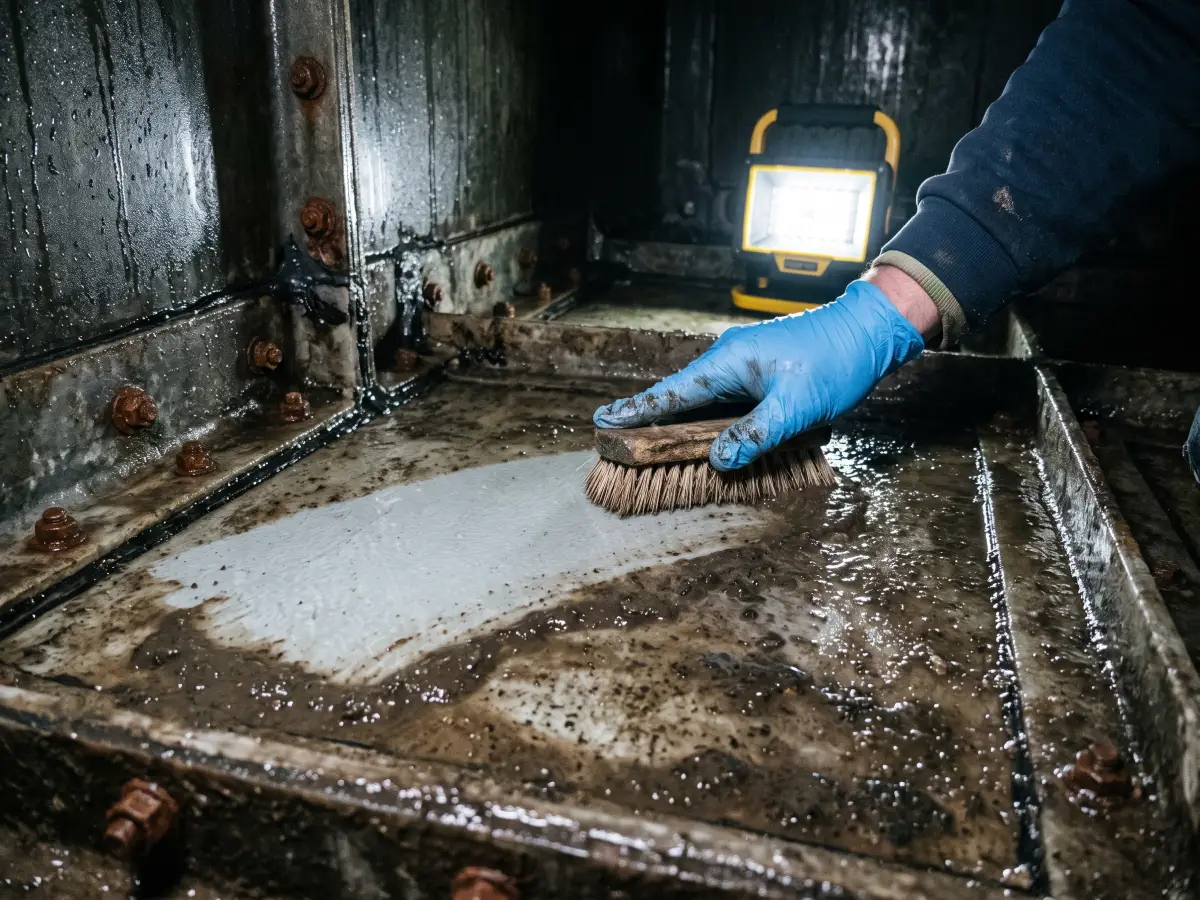
- Cleaning and descaling Sediment, scale, rust, debris and biofilm physically removed from the base, walls and fittings while the tank is drained.
- Disinfection A disinfectant applied to the cleaned surfaces and held for its contact time, then rinsed and refilled.
- Asset register The list of tanks, their locations, sizes and construction confirmed and brought up to date, which is often where the audit finds its first surprise.
- Audit trail documentation A written report covering condition before and after, the work carried out, the laboratory results and the remedial actions arising, dated and kept with your water safety records.
The physical stage is covered in more detail on our water tank cleaning page, and the full range of work we carry out on stored water systems is set out under water tank services.
How often should water tanks be cleaned?
There is no interval set in law. Cold water storage tanks are commonly inspected annually and cleaned when that inspection shows it is due. Higher risk settings such as healthcare and care homes are usually scheduled more often. Your Legionella risk assessment sets the frequency for your building.
That answer frustrates anyone hoping for a single number, but it follows from how the duty is written. The assessment is the mechanism, and it reflects your building: the condition of the tanks, the temperatures actually being achieved, how much water the building uses, who occupies it and what the sampling history shows. Two identical tanks in the same street can justify very different schedules.
What is not defensible is having no schedule at all, or one that nobody has reviewed since the building changed use. If your last audit or clean was more than a year ago, or nobody can say when it happened, treat that as the finding rather than waiting for the next one. Timing helps too. Booking spring water tank cleaning deals with tanks before summer temperatures arrive, and our water tank inspection services cover the checks worth doing before a building stands empty over a shutdown.
Booking an audit or a clean
London Water Treatment carries out water tank cleaning, disinfection and hygiene audit work for residential and commercial properties across London and the surrounding areas, from our base in Brentford. Sampling is analysed by a UKAS accredited laboratory, and you receive the results together with a written record of the work and of anything found while the tank was open.
It helps to know the property type, how many tanks there are and roughly what size, where they sit, when they were last cleaned or inspected, and whether anything flagged last time is still outstanding. Across several buildings, say so at the outset, because a portfolio is usually better served by one review and a planned schedule than by a series of separate visits.
Call 020 4532 7773, or book an audit using the enquiry form and we will set out what the visit involves and how long it takes.
Put your tanks on a schedule
Tell us how many tanks you have, where they are and when they were last inspected, and we will tell you what an audit and clean cycle would look like.