
Water Hygiene Services Explained
Water hygiene turns up in compliance paperwork and contractor quotes without ever being properly explained. Here is what the services actually include, the law behind them, and how to compare providers in London.
What are water hygiene services?
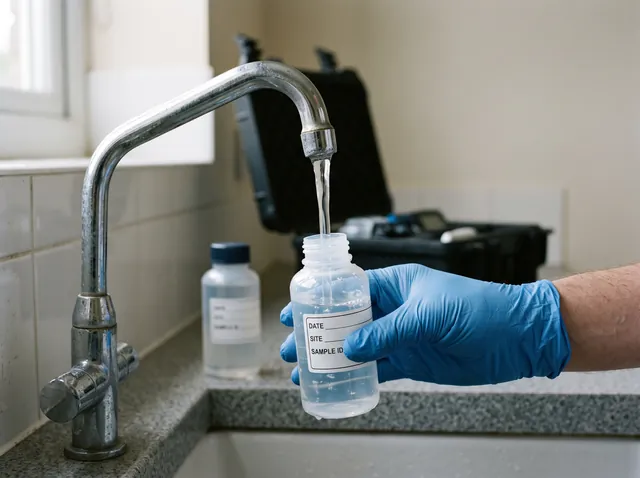
Water hygiene services are the tasks that keep a building's water systems clean, safe and legally compliant. They cover risk assessment, monitoring, sampling, cleaning, disinfection and remedial work. Rather than a single job, water hygiene is an ongoing programme aimed at controlling waterborne risk, above all Legionella bacteria, which causes Legionnaires' disease.
Where responsibility sits is what catches people out. Mains water arrives at the property boundary already treated and tested by the water undertaker. Past the incoming stop tap it becomes the responsibility of whoever controls the premises. Water stands still in tanks, warms up as it travels, and sits untouched in unused outlets. Water hygiene preserves quality rather than creating it, which separates it from what water treatment is in the broader sense.
In practice the programme is a rolling cycle: assess the system, put controls in place, monitor whether they hold, clean and disinfect when the evidence says so, and record all of it. A control you cannot evidence is not one an inspector will accept. See our commercial water hygiene services.
What is typically included?
A complete programme usually brings together several distinct services rather than one visit.
- Legionella risk assessment The survey that identifies where risk exists and sets everything else that follows. See what a Legionella risk assessment involves.
- Water temperature monitoring Checking that hot water stays hot and cold water stays cold, so neither sits in the range where bacteria multiply.
- Sampling and laboratory testing Samples analysed by a UKAS accredited laboratory, so the result stands up at audit. See Legionella testing and water sampling.
- Tank inspection, cleaning and disinfection Cold water storage tanks are the most common problem area. See water tank cleaning.
- Chlorination and disinfection Controlled disinfection of pipework, dosed, held, neutralised, flushed and sampled. See chlorination services in London.
- Remedial works Fixing what the risk assessment found, from removing dead legs to reinstating tank lids, screens and insulation.
- Record keeping The logbook that proves you are managing risk. Without it, the work you paid for is hard to demonstrate.
The legal side
There is no single piece of legislation called the water hygiene act. The duty is assembled from several sources. The Health and Safety at Work etc. Act 1974 places a general duty on employers and on people in control of premises. The Control of Substances Hazardous to Health Regulations 2002 treat Legionella bacteria as a substance hazardous to health. ACOP L8, the HSE's Approved Code of Practice, sets out how to comply, and HSG274 is the supporting technical guidance for hot and cold water systems.
An Approved Code of Practice is not legislation in itself. If you did not follow it, you have to show you achieved compliance another way, which is why ACOP L8 is the benchmark. Control starts with an assessment, which is where our Legionella risk assessments in London come in.
Who holds the duty
The responsibility falls on the duty holder: usually the employer, a self employed person, or the person in control of premises in connection with work, which in a let or managed building means the owner, landlord or managing agent. Appointing a contractor does not transfer it.
Who needs water hygiene services?
Almost any non domestic building with a water system needs some level of water hygiene management. That includes offices and commercial premises, care homes and healthcare settings, schools and colleges, hotels, gyms and leisure facilities, food and beverage premises, and landlords or managing agents responsible for residential blocks with communal water systems.
What varies is depth, not whether the duty applies. A small office fed straight off the main, with a handful of outlets in daily use, sits at the low risk end. The features that push a building up the scale are consistent: stored water, showers or anything else that creates a fine spray, cooling systems, long pipe runs, and outlets used rarely or not at all.
Occupancy matters too. Buildings serving people more vulnerable to infection, such as care and healthcare settings, are held to a higher standard because the consequences of losing control are more severe.
How often do you need them?
There is no single answer, because frequency is set by your risk assessment rather than a fixed national timetable. As a general guide, the assessment is reviewed regularly and whenever the system or its use changes, monitoring tasks run on a routine schedule, and cold water storage tanks are typically inspected annually.
- Risk assessment review Reviewed regularly, and after any change to the system, its use or its occupancy, or a case of Legionnaires' disease linked to the building.
- Routine monitoring Temperature checks and flushing of little used outlets, often monthly or quarterly depending on the assessment.
- Tank inspection Tanks are typically inspected annually, then cleaned and disinfected when the inspection shows it is needed.
- Event driven work Chlorination is triggered by events: new or altered pipework, disuse, a failed sample, or a mains connection needing certification.
Regular water hygiene audits keep the schedule honest, checking the tasks are actually being done and recorded rather than just written into a plan.
What happens if water hygiene is neglected?
The most serious risk is an outbreak of Legionnaires' disease, which can be fatal and is often traced back to poorly maintained water systems. Beyond the human cost, duty holders who fail to manage water safety can face HSE enforcement action, fines and, in serious cases, prosecution, and may find their insurance cover affected.
The failures that lead there are rarely dramatic. A tank lid left off after a repair. A wing closed for refurbishment with the outlets never flushed. A monitoring schedule that quietly lapsed when the responsible person left. None of them announces itself, which is why a recorded, repeated programme matters more than any single visit.
Staying on top of water hygiene is far cheaper and simpler than dealing with the consequences of ignoring it, and the recurring costs are modest and predictable. If you are budgeting, our page on how much a Legionella risk assessment costs sets out what drives the price.
How to choose a water hygiene company in London
Quotes are hard to compare because providers scope the work differently. These are the points worth checking.
-
Accredited sampling and testing
- Samples analysed by a UKAS accredited laboratory
- Results presented in a form you can file
- A clear route to action when a sample fails
-
Work carried out to the standards
- Assessments and works to ACOP L8 and HSG274
- Disinfection carried out to BS8558
- Recommendations tied to the guidance they come from
-
Documentation you can present
- A logbook that stands up at audit
- Certificates issued on completion
- A schedule of what happens next and when
Two further points are easy to overlook. The first is whether the full range of work is available in house, covering assessment, cleaning, chlorination and remedial work, because a provider who can only assess will leave you to source the fix. The second is local coverage: a resample after a failed result, or a disinfection needed before a handover date, is a response time question as much as a technical one.
Frequently asked questions
Is water hygiene a legal requirement?
Controlling Legionella risk is a legal duty under health and safety law and the HSE's Approved Code of Practice L8. Water hygiene services are not a single statutory item, but the tasks they cover, risk assessment, monitoring and control, are how duty holders meet that obligation.
What is the difference between a water hygiene company and a plumber?
A plumber installs and repairs. A water hygiene company specialises in assessing and controlling waterborne risk so that a building stays compliant. Many water hygiene tasks, including risk assessments, laboratory sampling and chlorination, need specific training and equipment rather than general plumbing skills.
Talk to a London water hygiene specialist
London Water Treatment provides water hygiene services across London and the surrounding areas, from Legionella risk assessments and water sampling to tank cleaning, chlorination and the remedial work that follows. If you are not sure where you stand, describe the building rather than the service: residential or commercial, whether water is stored or fed straight off the main, whether anyone has asked you for a certificate or an assessment, and the date you need it by. You can also request a quote in writing.
- ACOP L8 The HSE Approved Code of Practice behind the duty
- HSG274 Technical guidance for hot and cold water systems
- UKAS Accredited laboratory analysis behind every sample
Need water hygiene cover for your building?
Tell us about the property and where you are with compliance, and we will set out what the programme should include.