
Commercial Water Hygiene Services in Brentford and London
We look after the water systems in commercial buildings across London from our base in Brentford. Risk assessment, sampling, tank cleaning, chlorination, TMV servicing, and the records that prove it was done.
- Programmes built around ACOP L8 and HSG274 Part 2
- Water samples analysed by a UKAS accredited laboratory
- Based in Brentford, covering London and the surrounding areas
What are commercial water hygiene services?
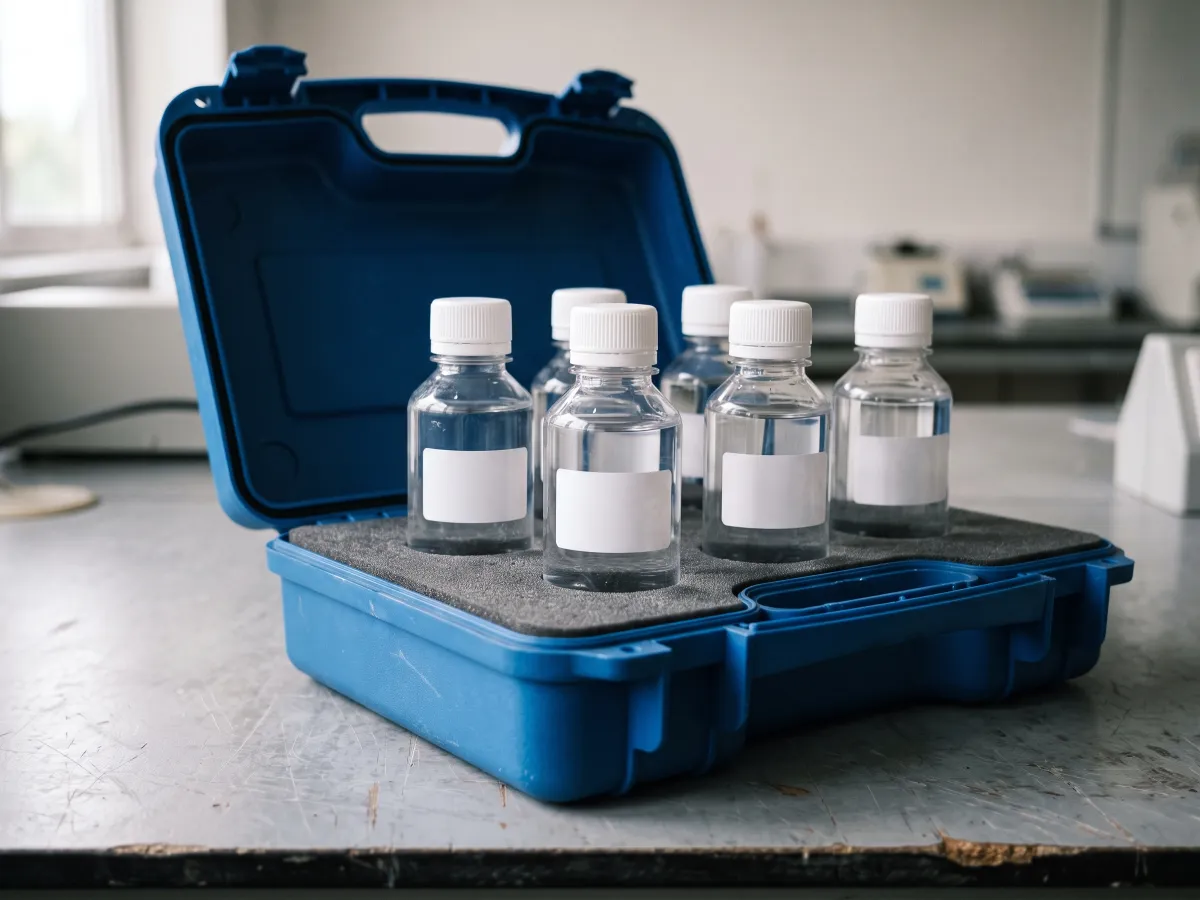
Commercial water hygiene services are the planned programme of assessment, cleaning, disinfection, testing and record keeping that keeps a building's hot and cold water systems safe to use, and evidenced as safe. For most premises that means a Legionella risk assessment, a written control scheme built from it, and monitoring on a fixed schedule.
A one off tank clean solves a problem on the day. A programme stops it returning, and produces the paperwork an insurer, an enforcing authority or an incoming tenant will ask for.
Scope is set by the building, not by a menu. A serviced office fed off the mains is a light programme. A hotel with tanks, calorifiers and hundreds of outlets is a substantial one. See what water hygiene services cover and what water treatment is.
Who needs commercial water hygiene services?
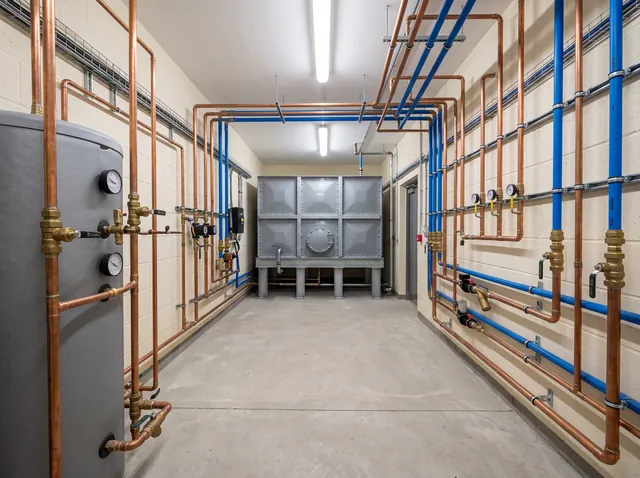
Anyone in control of premises used in connection with a trade, business or other undertaking, where water is stored or used and where droplets can be created and breathed in. That covers almost every commercial building in London, and residential blocks with communal tanks and risers.
- Offices and co-working Showers, tea points, long runs of little used pipework.
- Healthcare and care homes Vulnerable occupants, heavy documentation requirements.
- Hotels, spas and leisure Rooms empty between bookings, spray outlets throughout.
- Schools and universities Long holiday shutdowns that leave water standing.
- Retail and shopping centres Tenanted units on shared supplies and storage.
- Factories and warehouses Welfare blocks and emergency showers, rarely run.
- Residential blocks Agents and freeholders holding communal tanks and risers.
Buildings get riskier while they are quiet, because stagnation and warming are what Legionella needs. See summer Legionella risk.
What is included in our commercial programme
Legionella risk assessments
Everything follows from this. We survey and map the system, identify where water is stored, stagnates or becomes an aerosol, and rate each finding. You receive a written report, an action plan and a certificate stating the level of risk. See Legionella risk assessments in Brentford and Legionella risk assessments in London.
Water sampling and laboratory testing
Sampling is not automatic. The risk assessment decides whether it is needed, from which points and how often. Samples go to a UKAS accredited laboratory, so results hold up in an audit. Typical analyses are Legionella species, total viable counts, coliforms, E. coli and Pseudomonas aeruginosa. Legionella must be cultured, so results take around 7 to 10 days. See Legionella testing and water sampling.
Cold water storage tank cleaning and disinfection
Stored water is the highest risk part of most systems. Tanks collect sediment, scale and biofilm, they warm up, and a poor lid lets in light, dust and vermin. We drain, clean, disinfect, refill, dose, flush and sample. See water tank cleaning.
Chlorination and flushing
Two situations, one method. Pre commission disinfection of new pipework, and remedial chlorination where a system has failed a sample. Work follows BS8558: flush, dose, monitor the residual through the contact period, neutralise, flush again, sample. A certificate follows once the laboratory confirms the water is safe. See chlorination services in London.
TMV servicing and temperature profiling
Hot water must be stored hot to control bacterial growth and delivered cool enough not to scald. A thermostatic mixing valve resolves that, but leaves a short tepid run at the outlet. We check, service and fail safe test TMVs, and profile temperatures at sentinel outlets.
Monitoring, records and compliance documentation
A control scheme only counts if it is carried out and recorded. We run the monitoring, take temperatures, inspect tanks and outlets, flush little used outlets, and keep the log in one place.
The legal framework behind water hygiene
There is no Legionella Act and no Legionella Regulations. The duties come from general health and safety law: the Health and Safety at Work etc. Act 1974, the Control of Substances Hazardous to Health Regulations 2002, and the Management of Health and Safety at Work Regulations 1999. ACOP L8 and HSG274 explain how to meet them.
The distinction matters, because much water hygiene marketing describes ACOP L8 as legislation. It is not. It is an Approved Code of Practice, and the HSE is explicit about its standing.
If you are prosecuted for breach of health and safety law, and it is proved that you did not follow the relevant provisions of the Code, you will need to show that you have complied with the law in some other way or a Court will find you at fault.
HSE, ACOP L8, fourth edition 2013
You may use other methods, but you then have to show they met the law. The current version is the fourth edition of 2013. Legionella is a biological agent, so COSHH sits behind the assessment.
| Document | What it is | What it means for you |
|---|---|---|
| Health and Safety at Work etc. Act 1974 | Primary legislation | Section 2 covers employees, section 3 anyone else affected, section 4 those using the premises. |
| COSHH 2002 | Regulations | Legionella is hazardous to health, so assessment and control of exposure are required. |
| Management Regulations 1999 | Regulations | The framework for risk assessment and access to competent help. |
| ACOP L8, fourth edition 2013 | Approved Code of Practice | Not legislation, but it carries a special legal status in court. |
| HSG274 Part 2 | HSE technical guidance | The practical detail for hot and cold water systems. |
| BS8558 | British Standard | The standard behind flushing, disinfection and commissioning. |
For a fuller walkthrough, read ACOP L8 compliance for building managers.
What is the duty holder responsible for?
The duty holder is the employer where the risk is to employees or others, a self employed person, or whoever is in control of the premises in connection with work, for example a landlord who keeps responsibility for maintenance. That person must ensure the risk assessment is carried out, and that whoever carries it out is competent.
On a multi tenanted building the duty is often shared and rarely written down. A section 3 duty cannot be passed on by contract, so appointing a contractor does not transfer it.
- Assess the risk A suitable and sufficient assessment of the water systems on the premises.
- A written control scheme How the risk is controlled on that system.
- Implement and monitor Temperature checks, flushing, inspection and cleaning at the set frequency.
- Keep records Readings, sample results and remedial work, produced on request.
- Appoint a responsible person Competent, with authority and knowledge of the installation.
- Review the controls Check what is written down is what happens, and update it when it stops being valid.
How a commercial water hygiene contract is structured
Most commercial clients start with a risk assessment, then move to a recurring schedule set by what it found. There is no standard package, because the frequency of monitoring, sampling and tank cleaning depends on the system, the building's use and who occupies it.
- Initial conversation Property type, number of buildings, stored water or not, existing documentation.
- Risk assessment A full survey, findings rated, and a prioritised action plan.
- Remedial work where needed Dead legs removed, tanks cleaned, pipework chlorinated, insulation corrected.
- Control scheme and schedule The monitoring tasks, who carries out each, and how often.
- Delivery and records The scheduled visits, with readings and results recorded as taken.
- Review Brought forward when the system changes, occupancy changes or readings drift.
A sample above the level your scheme accepts is investigated rather than repeated. Multi site estates run to one report format and one contact.
Frequently asked questions
What is involved in a Legionella risk assessment?
We inspect and map your water systems, identify where risk exists, set out the control measures needed and document it in line with ACOP L8. You receive a written report with photographic evidence, a risk rating against each finding and prioritised recommendations.
How often should commercial water systems be checked?
It depends on what your risk assessment found. A common pattern is monthly temperature monitoring at sentinel outlets, quarterly inspections and an annual review. Higher risk systems are checked more often, and any significant change brings it forward.
Does a new water system have to be chlorinated?
Yes, in practice. BS8558 sets out that a new or altered system should be flushed, disinfected and confirmed by sampling before it is used. New pipework is not clean pipework: installation introduces dust, jointing compounds and debris.
Can you manage water hygiene across multiple sites?
Yes. We work with multi site operators using one report format and one point of contact, so results can be compared across the portfolio. Each site still receives its own risk assessment, control scheme and schedule.
Do I need to test the water in a vacant property?
An unoccupied building is a higher risk environment, not a lower one, because water sits still and warms up. Flushing and monitoring should continue through the void, and disinfection is often needed before the system is used again.
Arrange a water hygiene review
Call the team, or arrange a water hygiene review and tell us the property type, whether there is stored water, and what documentation you hold.