
Summer Legionella Risk: What Businesses Need to Do Now
Legionella does not take the summer off, it takes advantage of it. As ambient temperatures climb through May and into the warmer months, water systems that behaved perfectly well all winter start to sit closer to the range where the bacteria multiply. This is a commercial checklist: what your building is expected to have in place, what tends to be missing, and the four things worth sorting before the peak.
Why does Legionella risk increase in summer?
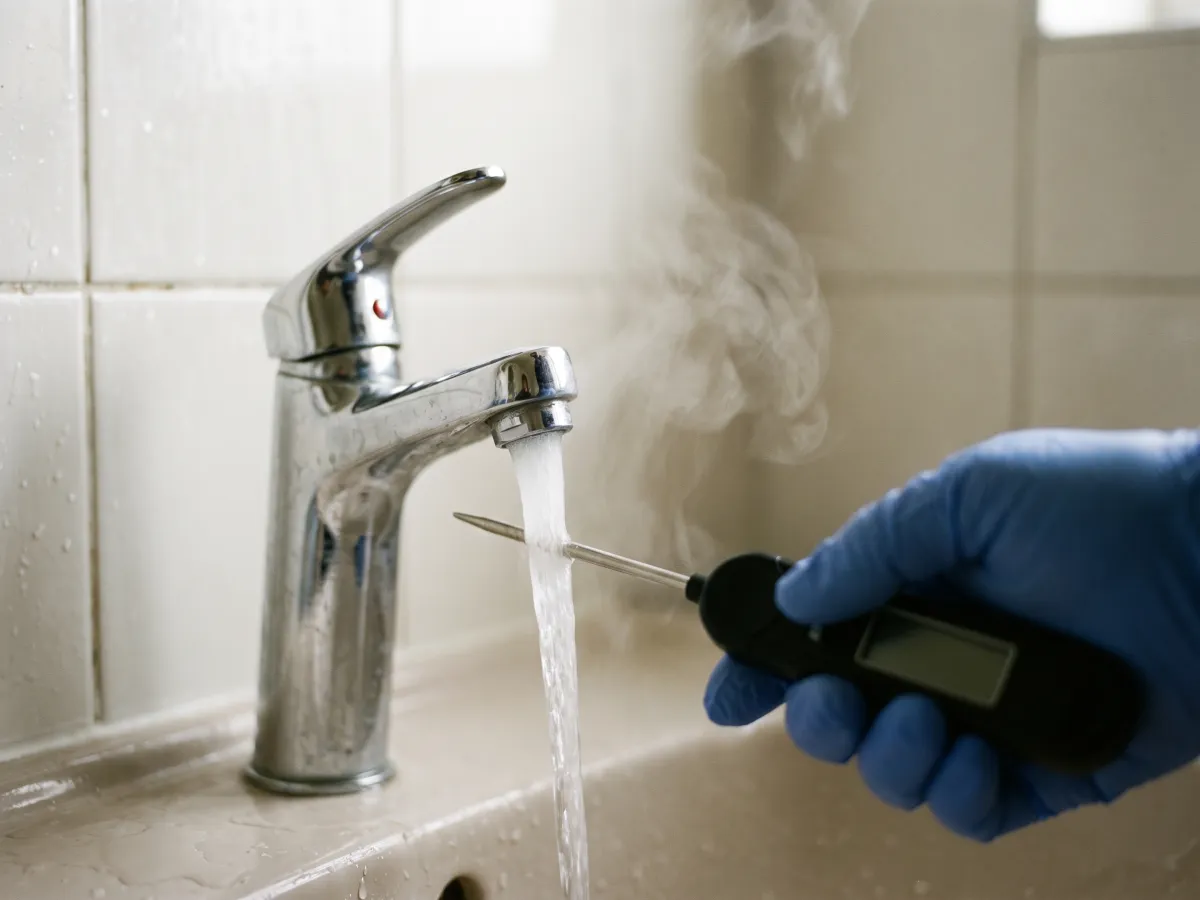
Legionella risk increases in summer because the three conditions that drive bacterial growth worsen at the same time. Stored water warms towards the 20 to 45 degrees Celsius range in which Legionella multiplies, areas of the building that are used irregularly stagnate, and the scale, sediment and biofilm built up over the year give the bacteria something to feed on.
Legionella bacteria are present at low background levels in most water systems all year round. That on its own is not the problem. The problem is concentration. When temperature, stagnation and nutrients line up, background levels can climb to the point where anyone inhaling fine water droplets from a shower, a spray tap, a hose or a cooling spray is exposed to a genuine health risk. Summer pushes all three in the wrong direction, which is why late spring is the sensible point to check that your controls still hold.
Temperature: stored water drifting above 20 degrees
Cold water is meant to be kept below 20 degrees Celsius. Cold water storage tanks in roof spaces, uninsulated plant rooms and south facing risers are the first places that stop achieving it, because they sit in air that can be far warmer than the water they hold. Once stored water drifts above 20 degrees and towards the 20 to 45 degree range, growth rates rise sharply. Long cold runs through warm ceiling voids do the same thing on a smaller scale, so a system can pass at the tank and fail at a distant outlet. Summer is the time to take temperatures at the sentinel outlets, not just the ones nearest the plant room.
Stagnation: the parts of the building nobody uses
Occupied buildings flush themselves. Areas that empty out do not. Meeting rooms booked once a fortnight, guest washrooms, showers in a changing room used by a handful of staff, a seasonal terrace bar, an unlet floor and a wing closed for refurbishment all hold water that sits still for days. Holiday periods make it worse, because the pattern of use across the whole building changes at exactly the point in the year when the water is warmest. Any outlet that goes unused for a week or more should be on a documented flushing schedule.
Nutrients: what has settled in the tank since last summer
Scale, sediment, rust particles, insect debris and biofilm accumulate slowly in cold water storage tanks and at the bottom of calorifiers. A tank last cleaned more than twelve months ago will usually have a visible layer of it. That layer is a nutrient source and a shelter, protecting bacteria from the temperature and disinfection controls that would otherwise keep numbers down. It is also the one risk factor on this list you can remove completely in a single visit.
What are commercial buildings required to have in place?
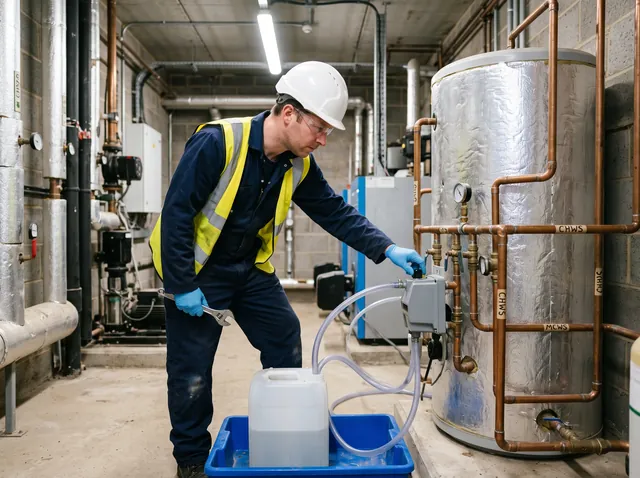
A commercial building needs three things: a current Legionella risk assessment carried out by a competent person, a written scheme setting out the control measures for that specific building, and records proving the monitoring and maintenance is actually being carried out. Those are the documents an inspector, insurer or incoming tenant will ask to see.
The requirement does not come from a Legionella Act, because there is no such thing. It comes from general health and safety law. The Health and Safety at Work etc. Act 1974 and the Control of Substances Hazardous to Health Regulations 2002 create the duty, and the HSE Approved Code of Practice, ACOP L8, explains how to meet it. ACOP L8 is not legislation, but it has a special legal status: if you are prosecuted and it is shown you did not follow the relevant provisions, you must demonstrate you complied some other way or a court will find you at fault. The technical detail for hot and cold water systems sits in HSG274 Part 2, which is guidance rather than an Approved Code. Our longer piece on ACOP L8 compliance for building managers sets the framework out in full.
A current Legionella risk assessment
ACOP L8 requires a suitable and sufficient assessment identifying and assessing the risk of exposure to legionella bacteria from work activities and water systems on the premises. The dutyholder is responsible for ensuring it is carried out, and that duty falls on the employer, the self employed person, or whoever is in control of the premises in connection with work. Where a building is let but the landlord retains maintenance responsibility, the landlord is the dutyholder. That duty cannot be contracted away.
A written scheme of control
The assessment feeds a written scheme describing the precautions for your building: temperature regimes, flushing frequencies, tank inspection intervals, who does each task and how it is signed off. A generic template is not a scheme of control. It should name your assets and reflect how your building is actually used, including the areas that empty out over the summer.
Monitoring and maintenance records
Records are the part that most often lets an otherwise well run building down. Hot and cold temperature checks at sentinel and rotating outlets, calorifier and tank inspections, flushing logs for low use outlets, shower head cleaning and descaling, and any remedial work all need recording. Where good practice is happening informally but nothing is written down, there is no evidence the controls exist. In compliance terms that is close to not having them.
The issues most often found at this time of year
When commercial buildings are reviewed in spring and early summer, the same five findings come up again and again.
- Tanks not cleaned within twelve months Cold water storage tanks with sediment on the base, scale on the walls, corroded fittings or a lid that no longer seals against dust, insects and light. Light is the one people forget, because it drives algal growth inside the tank.
- Risk assessments that no longer match the building An assessment carried out before a refurbishment, a change of tenant or a change of occupancy is out of date whatever its age. The asset register in it no longer describes what is on site.
- Low use outlets outside the flushing regime Meeting room taps, guest toilets, showers and seasonal facilities that were never added to the schedule, usually because they were installed or reopened after the assessment was written.
- Dead legs left behind by refurbishment Capped spurs and redundant pipework left in place when a kitchen, washroom or partition wall moved. They hold warm, still water permanently and no flushing regime reaches them.
- No usable records Temperature readings kept on a clipboard that has gone missing, or a log book that stops eighteen months ago. Without records you cannot show the scheme of control has been applied.
- Nobody clearly named as responsible The competent person has left, changed role or was never formally appointed, so tasks that should be scheduled are happening only when somebody remembers.
Four things to do now
Taken in advance these are routine visits. Taken in response to a positive sample or an enforcement letter, they are considerably more disruptive.
1. Book a water tank inspection and clean
If your cold water storage tank has not been professionally cleaned and inspected in the last twelve months, book it before the warm weather sets in. A clean drains and isolates the tank, removes sediment and biofilm, disinfects the internal surfaces and refills the system, and the inspection that goes with it picks up lid and screen defects, corrosion, insulation faults and poor turnover that would otherwise go unnoticed. Our water tank cleaning service covers commercial and residential properties across London with laboratory testing and a written report on completion. If you are planning ahead for next year, spring water tank cleaning explains why April is the practical window.
2. Review or commission a Legionella risk assessment
There is no fixed expiry date in ACOP L8. An assessment should be reviewed regularly and whenever there is reason to think it is no longer valid, which includes changes to the water system, changes to the way the building is used, changes in occupancy, a period of low or no occupancy, or control measures that are not performing. Two years is a common review baseline, but a refurbishment last autumn matters more than the date on the cover. We carry out same day Legionella risk assessments in London where a review is urgent, with the written report provided on the day.
3. Check your flushing records
Walk the building and list every outlet that is not used at least weekly, then check each one appears on the flushing schedule. Flushing means running the outlet long enough to draw fresh water through the full length of the branch, at both hot and cold where both are present, with the record signed and dated. Showers and spray taps need particular care because they generate the aerosol that carries the bacteria, so run them gently or remove and disinfect the head rather than creating a spray.
4. Arrange a chlorination if the assessment calls for it
Where an assessment, an inspection or a sample result identifies contamination, a disinfection of the affected tank or pipework may be required. The system is dosed to a controlled concentration, held for the required contact period, thoroughly flushed and then sampled to confirm the water is fit for use. Our chlorination services in London cover commercial and residential systems and can usually be arranged at short notice where the response is urgent.
What is at stake if it is left
Legionnaires' disease is a serious form of pneumonia, and the people most affected by it tend to be older occupants, smokers and anyone with a weakened immune system. Those are exactly the groups found in care homes, hospitals, hotels and residential blocks, which is why the duty is set where it is.
For a dutyholder, the consequences of a failure go beyond the immediate health risk. The HSE can serve improvement and prohibition notices and can prosecute. Civil claims, insurance disputes, contract exclusions and the practical cost of closing a building or a floor while it is remediated all follow from the same gap. Under section 3 of the Health and Safety at Work etc. Act 1974 the duty to people who are not your employees cannot be passed on by means of a contract, so appointing a maintenance provider does not move it away from you.
None of that is likely for a building with reasonable, documented controls in place. The point of doing this in late spring is that confirming your arrangements is a small job and reacting to a failure is not.
Getting support through the summer
London Water Treatment works with commercial clients across London and the surrounding areas from our base in Brentford. Risk assessments, water sampling and testing, tank cleaning and inspection, disinfection, chlorination and ongoing monitoring all sit with one team, so a finding from an assessment can be actioned without bringing in a second contractor and repeating the survey. Our commercial water hygiene services page sets out what that covers for a managed building.
If you are not confident your arrangements will hold through the summer, the useful first step is a short conversation about the building: whether there is stored water, when the tank was last cleaned, how old the assessment is and which areas empty out over the holidays. That is usually enough for us to tell you whether you need a full review or a single visit. Call 020 4532 7773 or contact our team and we will scope it properly.
Get your building checked before the peak
Tank cleaning, Legionella risk assessments and chlorination across London, with written documentation on completion.