
Legionella Testing and Water Sampling in London
If your risk assessment has recommended sampling, or a result has come back positive, this guide explains what Legionella testing involves, what the numbers mean, and what you are expected to do next.
What is Legionella testing?
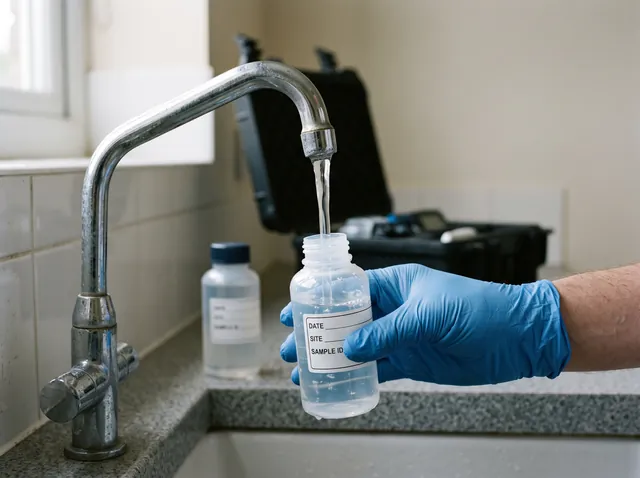
Legionella testing is the laboratory analysis of water samples to find out whether Legionella bacteria are present in a water system, and at what concentration. Samples are taken from representative points such as tanks, outlets and returns, sent to an accredited laboratory, cultured, and reported as colony forming units per litre, or CFU/L.
A risk assessment tells you where conditions could allow Legionella to grow. Testing tells you whether bacteria were actually there on the day. A sample is a snapshot of one point at one moment, so testing supports a control regime rather than replacing one.
Legionella testing or a Legionella risk assessment?
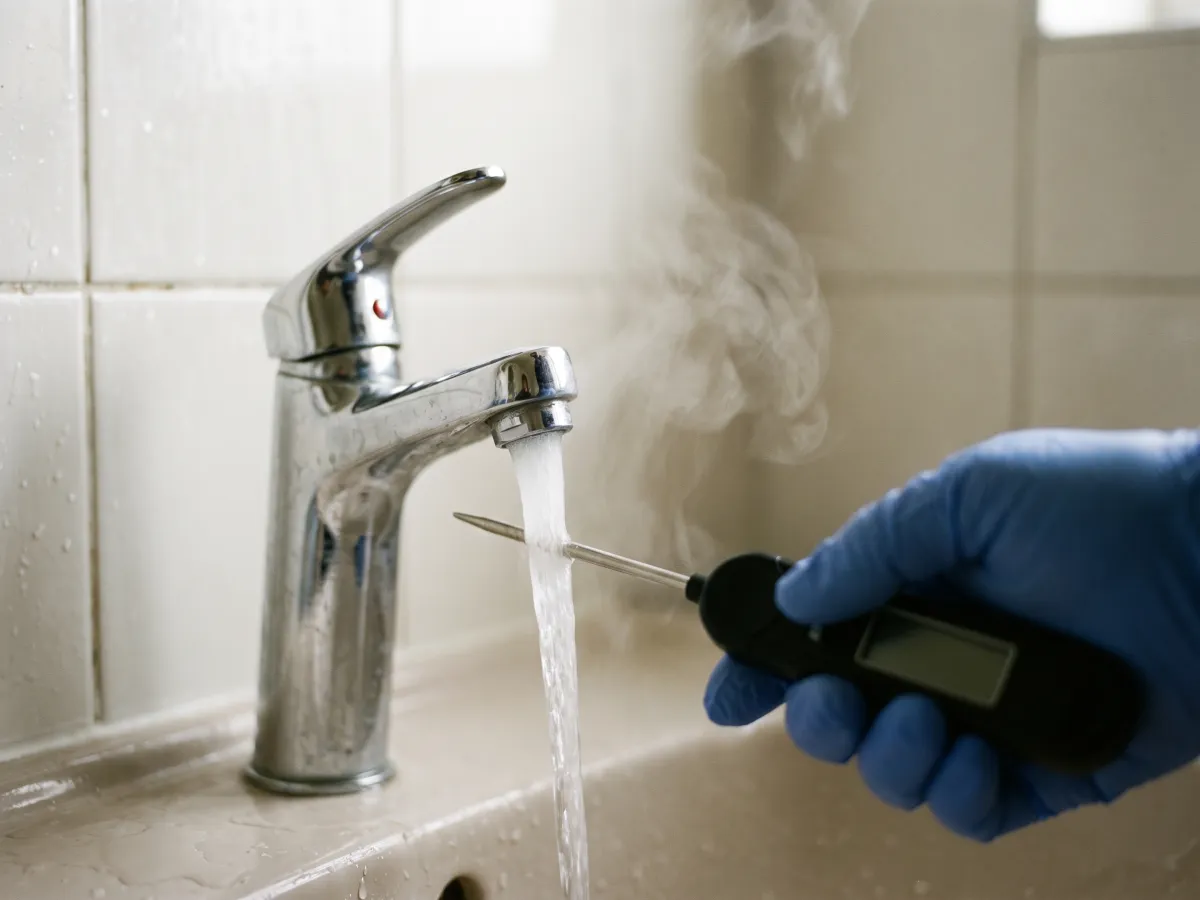
They are two different pieces of work. A Legionella risk assessment is a survey of your system that identifies where conditions could let the bacteria grow and sets out how to control that risk. Legionella testing is the measurement that confirms whether bacteria are present. The assessment comes first, and it decides whether sampling is needed at all.
Sampling a system you have never assessed produces a number with no context, because nothing tells you which outlets matter or what a result should trigger. Start with what a Legionella risk assessment involves, check how much a Legionella risk assessment costs before comparing quotes, and see our Legionella risk assessments in London.
When do you need Legionella testing?
You need Legionella testing where your risk assessment calls for it, where temperatures cannot reliably be held outside 20°C to 45°C, in higher risk systems such as those with stored water or showers, in healthcare and care settings, after remedial work, after a positive result, and where a system has been out of use.
- Your risk assessment recommends it The most common trigger. It names the points and the frequency.
- Temperatures cannot be held Where hot water runs cool or cold water runs warm, temperature no longer proves control.
- Higher risk systems Stored water, showers, spa pools and cooling towers, where an inhaled aerosol is the route into the lungs. Healthcare and care settings more closely again.
- After remedial work Sampling evidences that a clean, a disinfection or an alteration achieved what it should.
- After a positive result Further samples establish the extent, then confirm control is regained.
- Systems out of use Vacant floors, unused outlets, anything stagnant after a shutdown, or a system with no monitoring records.
HSG274 Part 2, The control of legionella bacteria in hot and cold water systems, sets out when sampling is appropriate. It supports the Approved Code of Practice L8, which requires a suitable and sufficient risk assessment and carries special legal status.
How the sampling process works
Sampling follows BS 7592, the code of practice for sampling for Legionella bacteria, and is carried out by a competent technician.
- Agree the sample points Points come from the risk assessment: typically the storage tank, the calorifier flow and return, and the nearest and furthest sentinel outlets. At an outlet, a pre flush sample reflects the outlet itself and a post flush sample reflects the wider system.
- Take the samples Bottles contain a neutraliser so residual chlorine cannot keep killing bacteria in transit. Water temperature is recorded, and samples travel cool and out of the light.
- Laboratory culture Bacteria must grow into countable colonies, which is why results usually take around 7 to 10 days.
- Report Results are given in CFU/L for each point, with an interpretation of whether action is required.
Your report should name each sample point, give its result, record the temperatures taken, state the laboratory and method, and say whether an action level has been reached. Keep it with your written scheme.
Understanding your Legionella test results
Results are reported in colony forming units per litre, CFU/L. HSG274 Part 2 sets out commonly applied action levels: not detected or up to 100 CFU/L means the system is considered under control, over 100 and up to 1,000 CFU/L calls for resampling and a review of controls, and over 1,000 CFU/L requires immediate action.
| Result | What it indicates | What is expected of you |
|---|---|---|
| Not detected, or up to 100 CFU/L | System considered under control. | Maintain your regime and keep the result on file. |
| Over 100 and up to 1,000 CFU/L | Low level contamination, or a system starting to become colonised. | Resample and review controls. If most samples are positive, or levels persist, take remedial action. |
| Over 1,000 CFU/L | The system is not under control. | Immediate action, including a review of controls and remedial measures such as disinfection. |
Read the numbers alongside the picture. One positive sentinel outlet on an otherwise clear system points at something local, such as a dead leg. Several positives implicate the system.
What to do after a positive result
Do not act on the number alone. Review the risk assessment and the control measures first, find out why the result happened, then act proportionately. Disinfect where warranted, resample to confirm the system is back under control, and record every step and the reason for it.
- Check the obvious first Temperatures at the affected points, stagnation, dead legs, tank condition, and any recent work.
- Review the risk assessment If it did not predict the problem, the assessment needs updating, not just the plumbing.
- Take remedial action Flushing, temperature corrections, removing dead legs, cleaning and disinfecting the tank, or full system disinfection.
- Resample to confirm Without follow up sampling you have acted but produced no evidence that it worked. Record the results, the decisions and the work in your written scheme.
Where the tank is implicated, the answer is usually a clean and a disinfection together, because disinfectant cannot work through sediment or scale. See water tank disinfection. Where pipework is the problem, see our chlorination services in London.
How often should you test for Legionella?
There is no fixed interval that applies to every building. Your risk assessment sets the frequency, based on the type of system, how it is used and how reliably controls such as temperature can be maintained. Some systems need no routine sampling at all. Complex or higher risk ones are sampled regularly.
Certain events reset the interval anyway: a change of use, refurbishment, a shutdown, a monitoring failure, or a suspected case of illness associated with the building.
Sampling sits inside a wider routine that includes monthly sentinel outlet temperature checks and periodic inspection of the cold water storage tank, as described in HSG274 Part 2. Read what water hygiene services cover to see how the pieces fit together.
Why UKAS accreditation matters
UKAS is the United Kingdom Accreditation Service, and its accreditation is the recognised mark of a laboratory's technical competence. Using a UKAS accredited laboratory means your results were produced to a recognised quality standard, which is what makes them stand up in an audit, an insurance claim or an investigation.
Ask which laboratory the samples go to, and whether it holds UKAS accreditation, before you book. A result from an unaccredited laboratory may be accurate, but it is harder to defend, and repeating the sampling lands on top of any remedial cost.
When you book sampling with us, analysis is carried out by a UKAS accredited laboratory, and the report names the sample points and the results obtained.
Frequently asked questions
Is Legionella testing a legal requirement?
Testing itself is not automatically mandatory, but controlling Legionella risk is a legal duty under the Health and Safety at Work etc. Act 1974 and the Control of Substances Hazardous to Health Regulations 2002, with the Approved Code of Practice L8 setting out how to comply. Your risk assessment determines whether sampling is needed to show the system is under control.
How long do Legionella test results take?
Because the laboratory has to culture the sample, results typically take around 7 to 10 days. Faster methods exist for indicative screening, but culture remains the standard for confirmed results, so allow for laboratory time when planning around a sampling visit.
What is the difference between water sampling and Legionella testing?
They describe the same activity from different angles. Water sampling is collecting the water from agreed points. Legionella testing is the laboratory analysis of that sample for Legionella bacteria. In practice a quote for one includes the other.
Book Legionella testing in London
London Water Treatment provides Legionella testing and control across London and the surrounding areas, from our base in Brentford, for residential and commercial properties. That covers sampling with UKAS accredited analysis, risk assessments, tank cleaning and disinfection, and the remedial work that follows a result.
Tell us the property type, the system, whether there is a cold water storage tank, and whether you are acting on a recommendation or a result already received. Call 020 4532 7773, or book Legionella testing using the enquiry form.
Need Legionella sampling arranged?
Send us your risk assessment findings or your latest result and we will tell you what sampling is needed.