What Is Water Treatment?
A plain English explanation of what water treatment means, how drinking water and waste water are treated, and which parts of it apply to a building in London.
What is water treatment?
Water treatment is the process of changing or protecting the quality of water so that it is safe and fit for its intended use. It covers removing contaminants such as sediment, chemicals and harmful microorganisms before water is drunk or used, and keeping water safe once it is inside a building's pipework and storage.
In the UK the phrase covers three different jobs, and most confusion comes from mixing them up.
Public supply treatment. Mains water is treated and tested by your water undertaker against the standards for public drinking water supplies. It arrives at the property boundary fit to drink.
Treatment inside the building. Past the incoming stop tap, responsibility shifts to whoever controls the premises. Water sits in tanks, warms up as it travels, stands still in rarely used outlets, and picks up sediment, scale and biofilm. This work preserves quality rather than creating it, which is why the industry calls it water hygiene. That is the part of the field we work in, and our guide to what water hygiene services cover goes further.
Waste water treatment. The cleaning of water after use, before it returns to the environment. Separate plant, separate operators, separate regulation, and covered next.
The main goals of water treatment
Whatever the setting, treatment aims at the same short list of outcomes.
- Removing harmful microorganisms In an occupied building the organism driving the work is Legionella, which multiplies in warm, still water and causes illness when inhaled in fine droplets.
- Reducing chemical contaminants Metals picked up from old pipework, and anything entering through backflow or a cross connection.
- Improving taste, smell and clarity Usually a symptom of something upstream: a disturbed main, a dirty tank, corrosion, or a dead leg.
- Controlling scale Hard water is normal across London, and scale gives bacteria a rough surface to colonise, so it is a hygiene problem as well as an efficiency one.
- Proving the result Laboratory analysis turns "the system was cleaned" into a record an inspector can rely on.
What is waste water treatment?
Waste water treatment is the cleaning of used water before it is returned to the environment. It handles water leaving toilets, sinks, showers, kitchens and industrial drains, and its purpose is to remove solids, organic matter, nutrients and pathogens so the discharge does not pollute rivers, lakes or coastal waters.
- Primary treatment Physical. Screens take out rags and grit, then the flow slows so solids settle as sludge and grease is skimmed off.
- Secondary treatment Biological. Bacteria break down the dissolved organic matter that settling cannot remove.
- Tertiary treatment Polishing. Further filtration, nutrient removal and disinfection, where the discharge permit demands it.
It is run by the sewerage undertakers and by operators of private plants, under discharge permits, and it is not a service we provide. It is worth keeping separate from clean water treatment, because the two get answered as though one company did both.
What is a water treatment system?
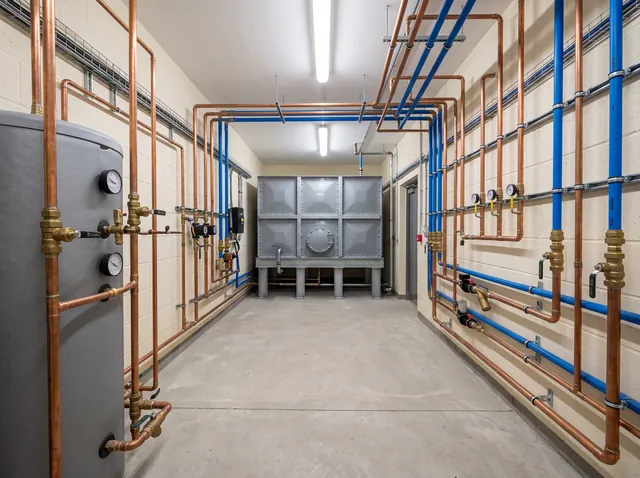
A water treatment system is any equipment or arrangement that changes or protects the quality of water. In a home that might be a filter or a softener. In a commercial or residential building it usually means the whole water services installation: the incoming supply, cold water storage tanks, distribution pipework, hot water plant and outlets.
The wider field includes point of use technologies advertised to homeowners: filtration, softeners, reverse osmosis and ultraviolet disinfection. Those are supplied by equipment specialists and are not services we offer. We work on the building system itself.
- Cold water storage tanks. The most common source of problems, because water stands still and warms up, and lids, screens and insulation are often missing.
- Distribution pipework. New runs, altered runs and dead legs left by earlier refurbishments, all needing flushing and disinfection.
- Hot water services. Calorifiers, cylinders and circulating loops, where the control is keeping hot water hot throughout.
- Outlets and little used fittings. Taps and showers needing a flushing regime, because stagnation turns a low risk system into a high risk one.
What water treatment means for a building in London
For most buildings it comes down to four things: disinfecting pipework and storage so the system starts clean, controlling the conditions that let bacteria grow, sampling to prove the water is safe, and keeping the certificates and records that show the person responsible has done what the law expects.
Disinfection of pipework and tanks
Chlorination is the controlled disinfection of a water system. It is dosed to a set concentration, held for a contact period, then neutralised, flushed and sampled. It follows BS8558, the British Standard for water services inside buildings, and is triggered by an event rather than a date: a new installation, altered pipework, disuse, a failed sample, or a mains connection the water undertaker will not approve without certification. Tanks are disinfected in the same work, after a physical clean. See our chlorination services in London and water tank services.
Legionella control
There is no single law called the Legionella Act. The duties come from the Health and Safety at Work etc. Act 1974 and the Control of Substances Hazardous to Health Regulations 2002, under which Legionella bacteria are a substance hazardous to health. ACOP L8, the HSE Approved Code of Practice, sets out how to comply, and HSG274 Part 2 is the technical guidance for hot and cold water systems. Control starts with a risk assessment. See our Legionella risk assessments in London.
Who holds the duty
Under ACOP L8 the duty holder is the employer, a self employed person, or the person in control of premises in connection with work, for example a landlord who maintains a let building. An Approved Code of Practice is not legislation, but if you did not follow it you must show you complied another way.
Sampling, testing and what happens if a result fails
Samples are analysed by a UKAS accredited laboratory, UKAS being the national body that assesses laboratories for technical competence, which matters because unaccredited results can be rejected. Analysis of a potable system typically covers total viable counts, coliform bacteria and E. coli, with Legionella where the assessment calls for it. A failed result is a starting point, not a verdict: find the cause, correct it, disinfect, resample and confirm.
Which of these do you actually need?
Start from the trigger, not the technology. New or altered pipework needs chlorinating and certifying before it goes into use. A duty as an employer, landlord or person in control of premises needs a Legionella risk assessment and a control scheme. Sediment, discoloured water or a failing tank needs tank work.
-
You are installing or altering pipework
- Flushing and disinfection before use
- UKAS accredited laboratory sampling
- Certificate on completion
-
You are responsible for a building or a let property
- Risk assessment of the water systems
- Monitoring, sampling and controls
- Disinfection and remedial work
-
You have a cold water storage tank
- Cleaning, disinfection and inspection
- Condition reporting and repairs
- GRP, plastic and sectional replacement
Getting advice on your system
If you are not sure which applies, describe the building and the trigger rather than trying to name the service. Tell us whether the property is residential or commercial, whether water is stored or fed straight off the main, whether anyone has asked you for a certificate or a risk assessment, and the date you need it by. That is usually enough to settle it in one call. See our water treatment services, or speak to our team.
- BS8558 The British Standard behind water services disinfection
- ACOP L8 The HSE Approved Code of Practice for Legionella control
- UKAS Accredited laboratory analysis behind every result
Not sure what your water system needs?
Tell us about the building and the deadline, and we will tell you which service applies and what it involves.