
Legionella Risk Assessment Services in Brentford
Brentford is where we are based, so it is where we get to fastest. Book an assessment on a flat, a block, an office, a school or a care setting, and get a written report you can hand to an auditor, an insurer or an incoming tenant.
- Same day Legionella risk assessments available
- Reports written against ACOP L8 and HSG274 Part 2
- Samples analysed by a UKAS accredited laboratory where needed
Booking a Legionella risk assessment in Brentford
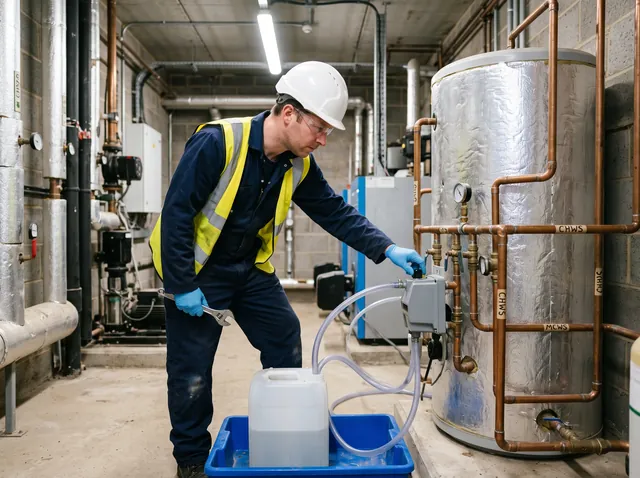
We assess water systems across Brentford and the surrounding west London areas from our base on the Great West Road, and same day Legionella risk assessments are available. A standard building takes around two to four hours on site. You receive a written report with a risk rating against every finding and a prioritised action plan.
Booking takes one short conversation. We need the property type, whether the building has stored water or runs straight off the mains, roughly how many outlets there are, whether there are showers or other spray outlets, and whether you hold a previous assessment or a logbook. That is enough to confirm scope, timing and price before anyone travels.
If you are still working out whether you need one, read what a Legionella risk assessment involves, or see how much a Legionella risk assessment costs. For the wider service across the capital, see Legionella risk assessments in London.
- ACOP L8 The Approved Code of Practice our reports are written against
- HSG274 HSE technical guidance, Part 2 for hot and cold water systems
- TW8 Our own postcode, so Brentford is a local visit not a call out
Who needs a Legionella risk assessment in Brentford?
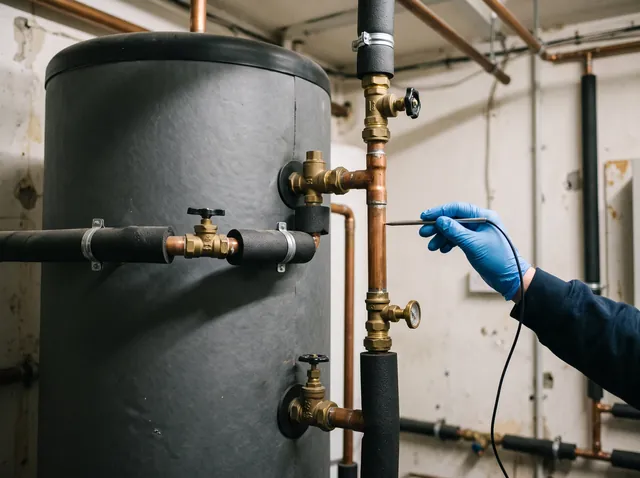
If you control premises in connection with a trade, business or other undertaking, water is stored or used there, and droplets can be created and breathed in, you need an assessment. That is the test set out in ACOP L8. It catches almost every commercial building in Brentford, and residential blocks with communal tanks and risers.
The duty holder is the employer where the risk is to employees or others, a self employed person, or whoever is in control of the premises in connection with work. A landlord who keeps responsibility for maintenance is in control of the premises. That duty cannot be handed to a contractor: appointing us does not move it, it evidences that you have discharged it competently.
- Landlords and letting agents Single lets and HMOs, where the assessment is what an agent is asked for at renewal.
- Managing agents and freeholders Communal cold water storage, risers and plant rooms in residential blocks.
- Offices and co-working space Showers, tea points and long runs of little used pipework.
- Schools and colleges Holiday shutdowns that leave water standing for weeks.
- Hotels, gyms and leisure Rooms and changing blocks that empty between bookings, spray outlets throughout.
- Care homes and healthcare Occupants far more vulnerable to infection, and heavier record keeping.
- Industrial sites and warehouses Welfare blocks and emergency showers, tested rarely and used less.
- Construction sites Temporary supplies, site cabins and welfare units on a live development.
Not every system needs elaborate control measures, but every system needs to be assessed before you can say so. For a busy commercial site, see our full commercial water hygiene services.
What happens on the day of the assessment
An assessor arrives, walks the whole water system with you or with your caretaker, and records what is actually installed rather than what the drawings say. Expect roughly two to four hours on site for a standard building, access to plant rooms, tank rooms and a sample of outlets, and photographs taken throughout.
- Systems walkthrough We trace the incoming main, storage, hot water generation, distribution and return, and note whatever has been altered, capped or added since installation.
- Asset capture Tanks, calorifiers, pumps, filters, softeners, thermostatic mixing valves and outlets are recorded, so the report describes your system rather than a generic one.
- Temperature readings Cold water is checked to see whether it stays below 20C, and hot water against the stored and distributed temperatures your scheme requires, at sentinel and representative outlets.
- Flow, use and stagnation Dead legs, blind ends, redundant branches, little used outlets and anywhere water is standing still.
- Tank and storage inspection Lid and hatch condition, insect screens, insulation, sediment, corrosion, light ingress, inlet and outlet arrangement and turnover of the stored volume.
- Aerosol and exposure review Where droplets are generated, who is exposed to them, and how vulnerable those people are.
- Control measure review What is already in place, whether it is being carried out, and whether the logbook matches reality.
- Close out on site A verbal summary before we leave, so anything urgent is known that day and not five days later.
Is water sampling included in the assessment?
Sampling is not automatic and it is not part of every assessment. The risk assessment decides whether samples are justified, from which points, and how often. Where they are needed, samples go to a UKAS accredited laboratory so the result stands up in an audit or an insurance claim.
Sampling is commonly indicated where temperature control is not being achieved, where the system has been out of use, where there is a suspected case or a complaint, where occupants are especially vulnerable, or after remedial work when you need to show the problem is resolved.
Legionella has to be cultured rather than read off a meter, so a laboratory result normally takes around seven to ten days. Other analyses often run alongside it, including total viable counts, coliforms, E. coli and Pseudomonas aeruginosa where the setting calls for it. There is more detail in our guide to Legionella testing and water sampling.
If a sample comes back positive, we investigate rather than resample and hope: where the sample was taken, what the temperatures were doing, whether storage or a dead leg explains it, and what has changed. The response is then proportionate, from increased flushing and monitoring, to a tank clean, to disinfection of the affected section, to a full chlorination followed by clearance sampling.
What you receive in your report
You receive a written Legionella risk assessment report, normally within three to five working days of the visit. It contains an executive summary, a description of the system, photographic evidence, a risk rating against each finding, prioritised recommendations with timescales, and a certificate confirming the assessment was carried out.
- Executive summary The overall position in plain language, readable without a water hygiene background.
- System description What is installed, where it runs, and where the risk sits within it.
- Findings with photographs Every issue evidenced, so nothing rests on an assessor's word alone.
- Risk rating Each finding graded, so you can see what is urgent and what is housekeeping.
- Prioritised action plan Recommendations with timescales, in the order they should be tackled.
- Basis for a written control scheme The monitoring tasks and frequencies that follow from the findings.
- Certificate of assessment Dated proof the assessment was carried out, for your compliance file.
ACOP L8 sets no fixed statutory interval for reassessment. It requires the assessment to be reviewed regularly and whenever there is reason to believe it is no longer valid, for example after changes to the water system, to how the building is used, or to occupancy. A two year review cycle is the pattern most buildings settle into, brought forward when one of those triggers occurs.
What we can do after the assessment
An assessment that lists actions nobody carries out has not reduced anyone's risk. We can complete the work as well as identify it.
- Monitoring and sampling Temperature checks at sentinel outlets, tank and outlet inspections, flushing of little used outlets, and scheduled sampling with the results recorded.
- Tank cleaning and disinfection Draining, physical cleaning, disinfection with the required contact time, refill and clearance sampling. See cold water storage tank cleaning in Brentford.
- Chlorination Remedial disinfection of a system that has failed a sample, and pre commission disinfection of new or altered pipework to BS8558. See chlorination services in Brentford.
- Remedial plumbing work Dead legs removed, redundant branches cut back, insulation corrected, tank lids and screens replaced, TMVs checked and serviced.
Where several actions are needed, they are sequenced so the building is disturbed once rather than four times, and so clearance sampling happens after the remedial work rather than before it.
Urgent and post incident assessments
Call us the same day if you have a suspected case, a positive sample, a scalding or contamination concern, or a building coming back into use after a shutdown. Same day Legionella risk assessments are available, and we will tell you on the phone what to stop doing while we are on the way.
The situations that need speed are consistent. A system idle through a void period, a refurbishment or a school holiday. A shutdown where storage warmed and outlets were not run. A reoccupation date that has moved forward. A tenant or employee reporting illness. In each case the useful first step is the same: find out what the system is doing before committing to a remedy. Flushing a building that needs disinfection wastes a week, and chlorinating a building that only needed its temperatures corrected wastes money.
Areas we cover from Brentford
We cover all of Brentford, including Great West Quarter, Boston Manor and Kew Bridge, along with the surrounding west London areas and London and the surrounding areas more widely. Our office is at Q West, 1110 Great West Road, Brentford TW8 0GP, which keeps travel time short for local jobs.
Brentford is a mixed patch and the water systems reflect it. Riverside apartment schemes with communal cold water storage and long risers. Converted period houses split into flats. Office buildings along the Golden Mile. Schools, gyms, care settings and light industrial units. Development sites where a temporary supply feeds welfare units before the permanent system is commissioned. The assessment is shaped around whichever of those you have.
Being local matters more than it sounds. Access is the usual bottleneck, because plant rooms and tank rooms need a key holder present. Working from a base in TW8 means a return visit for a missed tank room is an hour, not a rescheduled day.
Frequently asked questions
How often should a Legionella risk assessment be reviewed?
There is no fixed statutory interval. ACOP L8 requires the assessment to be reviewed regularly and whenever there is reason to believe it is no longer valid, for example after changes to the water system, its use, or occupancy, or after a suspected case. Most buildings settle on a two year review cycle.
Are landlords legally required to have one?
Yes, where the landlord is in control of the premises in connection with work. The duty comes from the Health and Safety at Work etc. Act 1974 and the Control of Substances Hazardous to Health Regulations 2002, with ACOP L8 explaining how to meet it. There is no separate Legionella Act.
How long does the assessment take and when do I get the report?
A standard building takes around two to four hours on site. The written report normally follows within three to five working days. Anything urgent is raised with you before we leave the site, so you are not waiting on a document to act on a serious finding.
Is water testing included in the risk assessment?
Not by default. The assessment determines whether sampling is justified, from where and how often. Where testing is needed, samples are analysed by a UKAS accredited laboratory, and Legionella results normally take around seven to ten days because the bacteria must be cultured.
Book a Legionella risk assessment in Brentford
Call the team, or book an assessment in Brentford and tell us the property type, whether there is stored water, and the date any report is needed by.