
Legionella Risk in Vacant Properties Over Winter
An empty building does not flush itself. Here is why a vacant property carries more Legionella risk than an occupied one, and what to check, flush and record before it is let again.
Why is a vacant property higher risk?
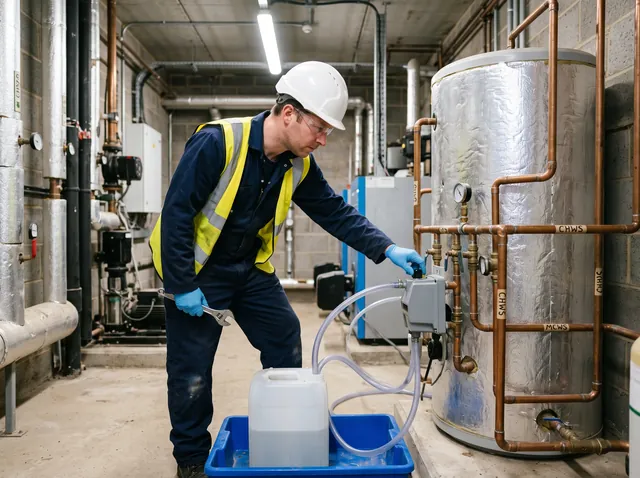
A vacant property is higher risk because nobody is using the water. An occupied building flushes itself daily through ordinary use of taps, showers and toilets. When that stops, water stands still in the pipework and the tank, drifts towards the 20°C to 45°C range in which Legionella bacteria multiply, and loses any disinfectant residual.
Winter makes it worse. Hot water left off or on a low setting sits lukewarm, which is the worst state of all: 60°C is hostile to Legionella, 35°C suits it. An unheated property also tracks the weather, so stagnant water warms in mild spells and cools again. Exposure comes from inhaling droplets rather than drinking, most often in a shower, and the first shower after a vacancy is usually an incoming tenant's.
What does the law say for landlords?
There is no single Legionella Act. The duty comes from the Health and Safety at Work etc. Act 1974 and the Control of Substances Hazardous to Health Regulations 2002, with the HSE Approved Code of Practice L8 setting out how to comply. It covers commercial premises and domestic rented property, and it is not suspended while a property is empty.
L8 is not legislation. It is an Approved Code of Practice, currently the fourth edition of 2013, which gives it an unusual status.
If you are prosecuted for breach of health and safety law, and it is proved that you did not follow the relevant provisions of the Code, you will need to show that you have complied with the law in some other way or a Court will find you at fault.
Approved Code of Practice L8, fourth edition, 2013
L8 names the dutyholder as the person in control of premises in connection with work, which covers a landlord who keeps responsibility for the water system. An empty property is still under that person's control, and a duty under section 3 of the 1974 Act cannot be passed on by contract, so appointing an agent does not move it. See our guide to Legionella risk assessments for landlords.
Cold water storage tanks in vacant properties
Stored water is the main reason an empty property needs checking rather than assuming.
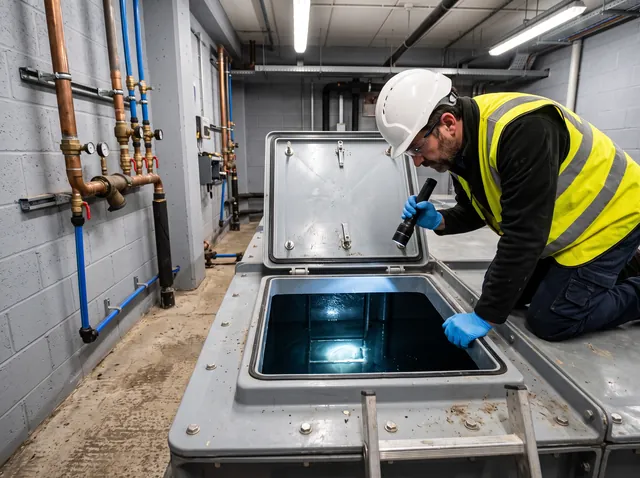
A tank is sized for a building in use, so once it empties there is no turnover and the whole stored volume stands static for the entire vacancy. In a cold loft that water is often safely below 20°C. In a mild spell, or above a heated flat, it is not.
- Lid and screens Close fitting lid, intact screens on vent and overflow, no gaps at pipe entries.
- Temperature Stored water below 20°C, measured rather than assumed.
- Insulation Tank and pipework insulated against loft temperature swings.
- Sediment and scale Debris on the base, scale on the walls, biofilm on the surfaces.
- Condition Corrosion, distortion, cracking or leaking joints.
- Turnover Whether the stored volume will realistically be used once the building is occupied.
Where sediment is found, the answer is a clean and a disinfection together, because disinfectant cannot work through sludge. See our water tank cleaning service and our guide to water tank inspection services.
What to do before a property becomes vacant
The cheapest time to deal with all of this is while the system is still in use.
- Get the assessment current It identifies the tank, the dead legs and the low use outlets, which is what tells you how much flushing the property needs. See what a Legionella risk assessment involves.
- Flush everything through Every outlet, hot and cold, until it runs to temperature, including the ones nobody uses: outside tap, second bathroom, utility sink, appliance fill points.
- Set the temperatures deliberately Hot water stored at 60°C or above and reaching 50°C at outlets within a minute, cold below 20°C within two minutes. Switching the hot water off for the winter is a water safety decision, not just a heating bill one.
- Deal with the tank and pipework Clean and disinfect the tank where the assessment calls for it, cut redundant pipework back to the main run, and disinfect the system where it has stood a long time. See our chlorination services in London.
Dead legs matter most during a vacancy. Pipework left behind after a bathroom was moved never flushes even in an occupied property, so in an empty one it becomes a reservoir feeding the rest of the system.
How often should you flush a vacant property?
Flush every outlet at least weekly for as long as the property stands empty. Run each tap and shower until the water reaches its normal temperature, working from the outlet nearest the incoming main to the furthest away, and flush the toilets. Record the date, the outlets flushed and who did it.
Weekly is the interval commonly applied to infrequently used outlets in HSG274 Part 2, the HSE technical guidance on hot and cold water systems. Flush cold before hot, and give the hot side long enough to pull hot water through rather than just empty the pipe. On showers, remove the head or bag it while it runs, so you are not filling a small bathroom with aerosol from the water you trust least.
| Record | Why it matters |
|---|---|
| Date | Evidences the interval between flushes. |
| Outlets flushed | Shows nothing was skipped. List them by room. |
| Temperatures | Hot reaching 50°C and cold below 20°C is the evidence your controls work. |
| Who did it | Ties the entry to a named person, which is what makes it a record. |
What should you do before reletting?
Before you relet, flush the entire system through, confirm hot water is stored at 60°C and cold water runs below 20°C, and review the risk assessment. Where the system has stood unused for a long period, or the tank is in poor condition, have it cleaned, disinfected and where necessary chlorinated before anyone moves in.
Reletting is the moment the risk transfers to someone else, so it is worth a fixed routine. Where the property has stood empty for months, the water is discoloured, or there has been work on the pipework, sampling and disinfection are more proportionate than another flush.
Worth telling the new tenant
Ask them to run the taps and showers through on moving in, and again after any period away of a week or more. It costs nothing and keeps the system moving between your own visits.
When should you book an assessment as a priority?
Book a Legionella risk assessment as a priority if the property has been vacant for more than a month, if it has a cold water storage tank, if there is no current assessment or flushing record, if the system is complex or has redundant pipework, or if the property is about to be relet.
- The property has been empty for more than one month, or will be.
- There is a cold water storage tank, cylinder or calorifier on the premises.
- No assessment exists, or it predates a change to the system or the use of the building.
- Nobody flushed the outlets during the vacancy, or there is no record of it.
- The heating or hot water has been off, or left low through the winter.
- The water is discoloured or has an odour, or the tank looks wrong under the lid.
None of these means the water is unsafe. They mean nobody currently knows, and knowing is the duty.
Arranging an assessment for a vacant property
London Water Treatment carries out Legionella risk assessments across London and the surrounding areas, from our base in Brentford, for residential and commercial properties. Assessments follow ACOP L8 and BS8558, same day assessments are available, and findings are documented so the report goes straight into your compliance file. We also carry out the work that follows: tank cleaning and disinfection, chlorination, sampling, and tank repair or replacement. See our Legionella risk assessments in London page.
Tell us the property type, how long it has been empty, whether there is a cold water storage tank, and when any new tenancy starts. Call 020 4532 7773 or book an assessment using the enquiry form.
Empty property to sort out before winter?
Tell us how long it has been vacant and whether there is a storage tank.