
Legionella Risk Assessments: A Practical Guide for Landlords
If you let residential property, Legionella belongs in the same bracket as gas and electrical safety: a risk you are expected to have assessed and written down. For most single lets the work is proportionate and quick. This guide covers what the duty is, how to assess a simple property, and when to call a specialist.
What are landlords responsible for?
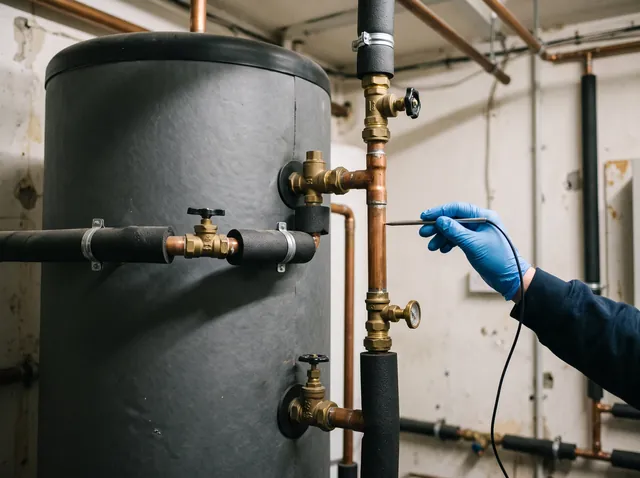
Landlords are responsible for assessing and controlling the risk of exposure to Legionella bacteria in the water systems of the properties they let, and for keeping a record of what they found and what they do about it. The duty comes from general health and safety law rather than from any Legionella specific act.
There is no Legionella Act and no Legionella Regulations. The obligation comes from the Health and Safety at Work etc. Act 1974 and the Control of Substances Hazardous to Health Regulations 2002, and the Health and Safety Executive sets out how it expects that to be met in its Approved Code of Practice, ACOP L8, fourth edition, 2013. L8 is not legislation, but it has a special legal status: if you are prosecuted and it is shown you did not follow the relevant provisions, you must show you complied with the law some other way, or a court will find you at fault.
L8 defines who holds the duty, and one of its three categories describes letting directly:
the person who is in control of premises or systems in connection with work, where there is a risk from systems in the building, eg where a building is let to tenants, but the landlord keeps responsibility for its maintenance.
ACOP L8, paragraph 28
Where a managing agent runs the property, your written agreement should say plainly who assesses, who flushes and checks temperatures, and who keeps the records. Allocating the tasks does not move the responsibility: L8 states that a duty under section 3 of the Act cannot be passed on by means of a contract. For the legal position in full, read your legal duties on Legionella.
Proportionality is built into the Code. Paragraph 25 states that all systems require a risk assessment, but not all require elaborate control measures. A flat on a combination boiler with no stored water is a short assessment with a short list of controls, and that is the correct outcome rather than a corner cut.
Where risk builds in a rented property
Legionella multiplies in water held between roughly 20C and 45C, where it has somewhere to settle and something to feed on. Illness follows when that water is broken into a fine spray and breathed in.
- Cold water storage tanks Uninsulated or badly lidded tanks let in light, dust, insects and debris, and sediment on the base feeds bacteria. Loft tanks warm up quickly in summer.
- Hot water cylinders A cylinder running below temperature, or one that stratifies so the bottom stays lukewarm, becomes a reservoir feeding every hot outlet.
- Dead legs and capped pipework Pipe runs left after a bathroom is moved or an appliance point removed hold water that never moves and never gets properly hot or cold.
- Shower heads and hoses Showers are the classic exposure route because they create fine aerosol at head height, and scale in the head shelters bacteria.
- Little used outlets Second bathrooms, en suites, cloakroom basins and garden taps sit unused for weeks, then release whatever has been sitting in them.
- Empty periods Voids between tenancies and student lets over the summer mean stagnation. See Legionella risk in vacant properties.
How to assess a simple rented property step by step
The sequence for a straightforward single let. Work through it with a thermometer, a torch and something to write on, and keep the notes.
1. Identify the water system layout
Work out how water gets in, where it goes and where it might sit still. Find the incoming main and stop tap, establish whether hot water comes from a combination boiler, a vented cylinder fed by a loft tank or an unvented cylinder, and list every outlet, including the forgotten ones: outside taps, appliance points, a wet room, any softener or filter. A rough sketch with the outlets marked beats a page of description, and it becomes the reference you check against next time.
2. Inspect water storage
If there is a cold water storage tank, look inside. You want a close fitting rigid lid, insulation, screened vents and overflow, clear water and no sediment, rust, scale or insects on the base. A tank in poor condition is the biggest single risk factor in a domestic system and needs cleaning and disinfecting rather than noting for later. Check the cylinder too. Our water tank cleaning service covers cleaning, disinfection and a certificate on completion.
3. Measure temperatures
Temperature is the main control in a domestic system, so measure it rather than assume it. Hot water should be stored at 60C or above and reach 50C or above at the tap within one minute. Cold water should stay below 20C, checked after running for two minutes. Test the furthest and least used outlets, not just the kitchen sink, because those are the ones that fail. Record every reading with the date.
4. Look for low use outlets and dead legs
Identify anything rarely run or no longer used: capped spurs from removed appliances, a shower in a spare bathroom, an outside tap in winter. Dead legs should be cut back to the live pipe where that is practical, because flushing one only ever partly works. Outlets that stay but are seldom used go on the flushing list instead.
5. Review current controls
Judge what is already in place against what you have found. Are little used outlets flushed, and by whom? Is the shower head descaled periodically? Is the cylinder thermostat set correctly and left alone? Are tenants told in writing to run taps and showers after a holiday and not to turn the boiler down? Are the checks recorded, or does it all live in somebody's memory? Gaps here become your actions.
6. Record your findings
Write it up even when the property is low risk, because an unrecorded assessment looks identical to no assessment when an insurer or an enforcing officer asks. A usable record holds a sketch or description of the system, the hazards found, who could be harmed, the controls in place, the actions needed with an owner and date against each, the temperature readings, and the assessment and review dates.
Can a landlord do the risk assessment themselves?
Yes, for a simple single let, provided you are genuinely competent to do it. ACOP L8 requires the dutyholder to ensure that whoever carries out the assessment and advises on prevention and control is competent. For HMOs, shared or communal water systems, care settings and commercial premises, use a specialist.
Competent means you understand how Legionella grows, can recognise the features of a system that let it, know the control measures and can judge whether the ones in place are working. No qualification is required, but more than one read of a checklist is. If you could not explain to an inspector why you rated an outlet low risk, you are not ready to sign the assessment off.
Bring in a specialist where a tank serves several dwellings, where there are communal risers or a shared plant room, where the building is an HMO or houses older or immunosuppressed occupants, or where the system has been altered and nobody has a drawing of it. For what a professional assessment contains, see what a Legionella risk assessment involves.
How long does a Legionella risk assessment last?
There is no fixed expiry date. An assessment stays valid until there is reason to think it no longer reflects the property. Two years is the common review interval for a simple low risk residential let, with annual review for higher risk or shared systems, and an immediate review after any change to the water system, its use or its occupancy.
Treat it as a living document, not a certificate with a date on it. Review it sooner when:
- The water system is altered, repaired or partly replaced, including a new boiler, cylinder or bathroom.
- Occupancy changes, for example a single let becoming a shared house, or an older or unwell tenant moving in.
- The property stands empty or lightly used, such as a void between tenancies or a student let over the summer.
- Temperature checks start failing, or the stored water looks or smells wrong.
- A tenant raises a water concern, or a case of Legionnaires' disease is associated with the property.
- The control measures you wrote down are not actually being carried out.
Record the review as well. A short dated note confirming nothing has changed is a perfectly good review, and it is evidence that you kept looking.
Do landlords always need to test the water?
Usually not. Routine Legionella sampling is not normally needed in a simple domestic let. Control measures do the work: hot water kept hot, cold water kept cold, little used outlets flushed and shower heads kept clean. Sampling is a targeted check, used where control cannot be demonstrated or the system carries a higher risk.
The distinction matters because a sample tells you about one outlet at one moment. It does not tell you the tank lid fits, the cylinder holds 60C or the spare bathroom gets flushed. The assessment, not the sample, is what the law expects of you.
Sampling becomes appropriate where temperature control is not being achieved, where stored water is visibly in poor condition, where occupants are more vulnerable to infection, after remedial work or disinfection, and where a system has stood unused. Analysis should come from a UKAS accredited laboratory, because results from an unaccredited one can be challenged by an insurer or enforcing authority. Our guide to Legionella testing and water sampling explains what is involved.
What happens if you do not comply?
Failing to assess and control Legionella risk is a health and safety breach, not an administrative oversight. Enforcement sits with the Health and Safety Executive or the local authority, and can run from improvement notices through to prosecution under the Health and Safety at Work etc. Act 1974 where someone is exposed or harmed.
The consequences that catch landlords out are usually indirect. Property and public liability cover assumes you are meeting your statutory duties, so a claim connected to the water system gets difficult where no assessment exists. HMO and selective licensing schemes commonly require evidence that health and safety risks have been assessed. Letting agents ask to see the assessment before taking a property on, and a missing record on one property can hold up a refinancing or a sale.
The recurring theme is evidence. The question is rarely whether the property was dangerous. It is whether you can show you looked, reached a reasonable conclusion and acted on what you found. A dated assessment with temperature readings and a short action list answers all three.
Booking an assessment
London Water Treatment carries out Legionella risk assessments in London for landlords, letting agents, managing agents and facilities managers, covering domestic and commercial systems. You receive a written assessment with the system recorded, hazards identified, temperature readings, a risk rating and a prioritised action list, plus the flushing and monitoring regime that keeps the property compliant between reviews. Where work is needed we can carry it out, from tank cleaning and disinfection through to remedial pipework.
Pricing follows the system rather than a menu, so a single let flat and a block with a communal tank are not quoted the same way. If you are budgeting for a portfolio, how much a Legionella risk assessment costs sets out what moves the price.
Tell us the property type, whether there is a cold water storage tank or a cylinder, roughly how many outlets, how many properties are in scope and whether an assessment already exists. Call 020 4532 7773 or book an assessment using the enquiry form. We cover London and the surrounding areas from our base in Brentford.
Need a Legionella risk assessment for a let property?
One flat or a full portfolio, we will assess the water system, record it properly and tell you exactly what needs doing.