
Mains Chlorination in London and What Thames Water Requires
Thames Water will not approve a new mains connection until the new pipework has been chlorinated, flushed, sampled and certified. Here is what that means for your programme.
Does Thames Water require a chlorination certificate?
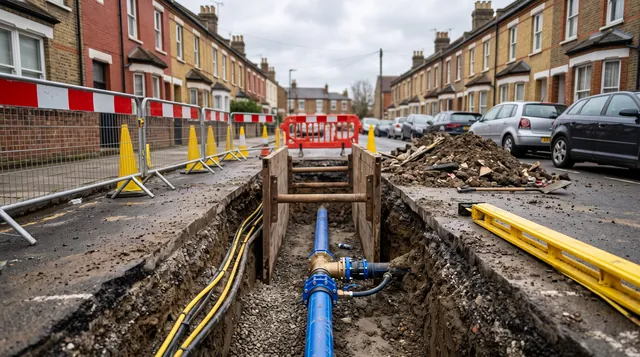
Yes. Thames Water requires new pipework to be chlorinated, flushed and tested before a new mains connection is approved, and the certificate must be backed by water sample analysis from a UKAS accredited laboratory. Until that certificate exists, the connection stage of the project cannot be signed off.
Thames Water will not accept new pipework into the public supply on trust. The certificate is the evidence that the pipework was disinfected and that the water inside it was independently tested. Developers usually meet this requirement at the point where everything else is finished and the site is waiting on water, so any problem lands on the critical path.
For detail on the document itself and who asks to see it, read our guide to the chlorination certificate. If you already know you need the work done, see our chlorination services in London.
Why mains chlorination is required
However carefully a site is run, the inside of a new main picks up contamination before it is ever commissioned.
- Storage and handling Pipe sits on site before installation, often outdoors, and open ends collect dust, soil and rainwater.
- Cutting and jointing Cut ends leave swarf inside the bore, and jointing compounds add organic material bacteria can feed on.
- Excavation A buried supply pipe is laid in ground carrying soil bacteria, and any open end is a direct contamination route.
- Standing water Water left in the system after pressure testing stagnates and lets biofilm establish on the pipe wall.
- Protecting the network The main point is not your building. It is stopping new pipework pushing contamination back into the public distribution network.
Chlorination deals with all of that in one controlled operation, and it is not the same as flushing. Flushing clears loose debris, but it does not disinfect the pipe wall and produces no evidence a certificate can rest on.
What the process involves
The method follows a set sequence, carried out in line with BS8558 and BS EN 806-4.
- Survey and planning We confirm the extent of the system, the isolation, dosing and sampling points, and where the neutralised water can be safely discharged.
- Isolation The new pipework is isolated so the chlorine solution cannot reach a live supply or an occupied system.
- Initial flush Loose debris and standing water are cleared. Skip this and the debris consumes the disinfectant before it reaches the far end of the run.
- Fill and dose The pipework is filled with a chlorine solution at the concentration the standard sets for the contact time being used.
- Contact period The solution is held in the system, usually at least an hour for a new installation, varying with size and complexity.
- Monitoring Concentration is checked at points around the system, not just at the dosing point, to confirm the level is held throughout.
- Neutralise and flush The system is flushed until the residual chlorine falls back within the acceptable range.
- Sampling Samples are taken from agreed points and sent to a UKAS accredited laboratory.
- Certification Once results come back satisfactory, the certificate is issued, recording the system treated, the method, the results and the date.
Analysis on a potable system typically covers total viable counts, coliform bacteria and E. coli. If a result is unsatisfactory the system is re-treated and resampled, which is why the cause matters as much as the result.
The same method applies to the supply pipe and to the distribution system inside the building. For the incoming main, see mains water chlorination. For a complete installation being commissioned from scratch, see new water system chlorination.
Why the laboratory must be UKAS accredited
Thames Water requires the certificate to be produced by a company using a UKAS accredited laboratory for the water sample analysis. UKAS is the United Kingdom Accreditation Service, and its accreditation is the recognised mark of a laboratory's technical competence, which is what makes the results dependable enough to accept.
This is the detail that catches projects out. The chlorination can have been done perfectly well, but if the samples went to a laboratory without accreditation the certificate can be rejected and the whole exercise repeated.
What to check before you book
Ask which laboratory the samples go to and whether it holds UKAS accreditation for the analyses being carried out, confirm the certificate will name the system treated and the results obtained, and check the turnaround quoted allows for laboratory time as well as time on site.
When you book with London Water Treatment, sample analysis is carried out by a UKAS accredited laboratory as standard, and the certificate records that analysis.
Chlorination for renovation and refurbishment
Mains chlorination is not only a new build requirement. Any project involving significant work to the internal pipework can trigger the same need for disinfection before the system goes back into service, because opening a water system up exposes the inside of it.
| Type of work | Disinfection usually needed |
|---|---|
| New mains connection | Yes, certified before Thames Water approves the connection. |
| Complete new internal distribution system | Yes, as the final stage of commissioning. |
| Replacing sections of existing pipework | Yes, for the altered pipework and anything it feeds. |
| New outlets, or extending an existing run | Usually, as new pipe enters a live system. |
| Repairs that open the pipework | Usually, since the inside of the pipe has been exposed. |
| Work involving the cold water storage tank | Yes, with a tank clean and disinfection alongside. |
Where a refurbishment touches the cold water storage tank as well as the pipework, the two jobs belong together, because chlorine will not disinfect through sediment or scale. That makes the refurbishment a practical moment to deal with the tank, particularly in older commercial buildings. See water tank cleaning for how that side of the work runs.
If you are not certain whether chlorination will be required, raise the scope with a specialist early. Establishing what is needed before work starts is far easier than arranging it at short notice.
How long does mains chlorination take?
For a straightforward residential or small commercial installation, the chlorination itself is usually completed within a working day. The limiting factor is laboratory turnaround for the water samples, normally one to three working days, so the certificate follows the site visit rather than arriving with it.
Larger systems take longer on site, because more of the network has to be filled, monitored and flushed. Access matters too: a supply pipe in an open trench is quicker to work on than a system threaded through an occupied building.
Same day certification is available and we take short notice bookings, but whether it is achievable depends on the size of the system and on laboratory turnaround. Tell us the date the certificate is needed by and we will give you a realistic answer before the work starts.
How to avoid delaying your connection
Leaving chlorination until the last minute is the most common cause of avoidable delay on site.
- Book before the connection date Work backwards from the date Thames Water is due to connect, allow for laboratory turnaround, and book the visit before that.
- Confirm the laboratory Check the analysis goes to a UKAS accredited laboratory before you appoint, so the certificate is not rejected later.
- Have the pipework finished The system must be complete and not still being altered. Any change after disinfection undoes it.
- Arrange water and drainage Flushing needs a supply to flush with and a safe, agreed route to discharge the neutralised water.
- State the deadline up front Give the date the certificate is needed by at enquiry, and allow contingency in case a sample has to be repeated.
- Keep the certificate Put it in the handover pack. It will be asked for again, by building control or at the next audit.
Booking mains chlorination in London
We provide chlorination across London for residential and commercial projects of all sizes, from a single dwelling with a new supply pipe through to multi unit developments. Work is carried out by experienced engineers, analysis is done through a UKAS accredited laboratory, and the certificate is issued on completion.
Tell us the property type, the extent of the new pipework, whether a cold water storage tank is involved and the date the connection is scheduled for. Call 020 4532 7773, or book a chlorination service using the enquiry form. For everything we cover, see our chlorination services in London.
Need a certificate before your Thames Water connection?
Tell us the system, the site and the date the certificate is needed by, and we will tell you what is achievable.