
New Water System Chlorination in Brentford
A newly installed water system is not a clean water system. Before handover it has to be flushed, disinfected, sampled and certified. Here is what pre commission chlorination involves, what you receive, and how to keep it off the critical path.
Does a new water system need chlorinating?
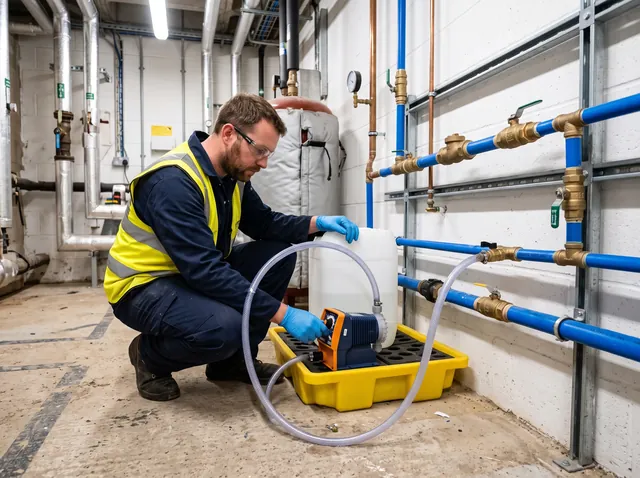
Yes. A new water system should be cleaned, flushed and disinfected before it is brought into use, then sampled to prove it is fit for service. BS8558 and BS EN 806-4 both treat disinfection as part of commissioning, and building control and the client will expect written evidence of it.
No single statute names chlorination. The duty comes from general health and safety law. ACOP L8, the HSE Approved Code of Practice on controlling legionella bacteria in water systems, supports the Health and Safety at Work etc. Act 1974 and COSHH 2002. It is not legislation, but it has a special legal status: depart from it and you must show you complied some other way.
For the local picture, see our chlorination services in Brentford. For everything we cover across the capital, see our chlorination services in London.
- BS8558 Standard our disinfection follows
- BS EN 806-4 Commissioning inside buildings
- ACOP L8 HSE code on legionella control
Why new pipework is not clean
What matters is the bore, and that picks up contamination from the day materials arrive.
- Storage on site Pipe, fittings and tanks sit outdoors with open ends, collecting dust, soil and rainwater.
- Cutting and jointing Cut ends leave swarf in the bore. Flux and lubricants add organic material bacteria feed on.
- Construction debris Plaster dust, sealant and site dirt enter open runs while other trades work around them.
- Pressure test water Test water often sits in the system for weeks, long enough for biofilm to form on the pipe wall.
- Stagnation A system installed early and commissioned last stands idle for months, and phased handover leaves sections unused.
Pre commission cleaning and flushing
Pre commission cleaning is the stage before disinfection. The system is filled and flushed at velocity to carry out debris, swarf, sediment and jointing residue. It is not optional. Debris left in the pipework consumes the disinfectant, so chlorine never holds the concentration it needs at the far end of the run.
This is the stage most often skipped on a tight programme, and the one that causes most repeat visits. A run holding flux residue and swarf uses up part of the dose before it reaches the outlets that matter, so samples fail and the week saved is lost twice over.
Flushing needs a water supply, an agreed discharge route and operable outlets. Dead legs and capped spurs are worth finding now, because they will neither flush nor disinfect properly.
The disinfection stage
A controlled and recorded sequence.
- Survey and method We confirm the extent of the system, the pipe materials, the isolation, dosing and sampling points and the discharge route, then issue a method statement and COSHH data.
- Isolation The new installation is isolated from anything in service, so disinfectant cannot reach an occupied system.
- Fill and dose Filled with a chlorine based solution at the concentration the standard sets for the contact time used, drawing every outlet, branch and tank through in turn.
- Contact period Around an hour on a straightforward installation, up to a full day on a large system with a storage tank and boosted distribution.
- Residual monitoring Concentration is measured around the system, not only at the dosing point. A reading below target means that part is not yet disinfected.
- Neutralise and flush Flushed until the residual returns to background, so nothing corrosive is left behind, discharging to the agreed route.
- Sampling Samples are taken from pre agreed points and sent to a UKAS accredited laboratory.
Where the incoming supply pipe is also new, that is a separate operation with its own certificate. See mains chlorination and Thames Water requirements.
Microbiological sampling after chlorination
Sampling turns a completed job into evidence. Samples are taken from agreed points after the final flush and analysed by a UKAS accredited laboratory. UKAS accreditation is the recognised mark of a laboratory's technical competence, and results from a laboratory without it can be rejected by building control.
| Analysis | What it indicates |
|---|---|
| Total viable colony count | The general bacterial population. A high count suggests poor cleaning or recontamination. |
| Coliforms | A broad indicator group. Their presence means the system is not fit to bring into use. |
| E. coli | A specific indicator of faecal contamination. Any detection means finding the cause and treating again. |
| Pseudomonas aeruginosa | An opportunistic organism found on wet fittings. Routinely required in healthcare settings. |
| Legionella | Requested where the risk assessment calls for it. Culture takes longer, so plan it in early. |
Turnaround is the part people underestimate. Site work can finish in a day, but the analysis still has to run, and Legionella culture takes longer than the indicators.
Certification and handover documentation
What belongs in the pack you hand over.
- Certificate of disinfection The system treated, the property, the method, the date and the engineer who did the work.
- Laboratory report Results from the UKAS accredited laboratory, showing sample points, analyses and values obtained.
- Method statement and COSHH data The disinfectant used, the contact time, and the neutralisation and discharge arrangements.
- Scope note or schematic A record of what was in scope, which matters when a building is handed over in phases.
Building control, the employer's agent, the incoming facilities manager and any future auditor all ask for the same document, so it belongs in the water safety logbook rather than somebody's inbox. Losing it means repeating the work, because a system cannot be proved clean retrospectively. See our guide to the chlorination certificate.
What happens if a sample fails?
A failed sample means the system cannot be signed off yet. The sequence is investigate, treat again, resample. The cause matters more than the result, because resampling without establishing why the first set failed usually produces the same failure, and another week of the programme is gone.
The causes are practical. A dead leg that never saw disinfectant. Pipework altered by another trade after chlorination. A storage tank not cleaned alongside, so clean distribution is fed from a dirty source.
We look at which point failed, which analysis failed and what changed in between, then treat and resample. We do not promise a first time pass, because that depends on the installation and on what happens after we leave.
Who this is for
Normally arranged by whoever hands the building over.
- Building contractors Principal contractors needing the water system signed off at practical completion.
- Plumbing and mechanical engineers Subcontractors who installed the system and need the disinfection evidenced.
- Housing developers New build residential, from single dwellings to blocks with tanks and boosted distribution.
- Facilities managers and landlords Whoever takes the building on at handover and becomes duty holder for the system.
- Fit out and refurbishment Where pipework is altered, the new work and everything it feeds need treating.
Where the system supplies drinking water in a care home, school, healthcare setting or food premises, further obligations apply. See potable water chlorination.
Frequently asked questions
How long does chlorination of a new water system take?
Most standard systems are flushed, disinfected and sampled within one working day on site. Larger installations with storage tanks and boosted distribution can take two days. Laboratory analysis runs afterwards, so the certificate follows the visit.
Is flushing the system on its own enough?
No. Flushing removes loose debris and standing water, but it does not disinfect the pipe wall and produces no laboratory evidence. It is what makes disinfection work, not a substitute for it. The certificate follows disinfection and sample analysis, in that order.
Can I get documentation for building control?
Yes. You receive a certificate of disinfection, the analysis report from the UKAS accredited laboratory and a method statement covering how the work was done. That is the pack building control and the client ask for at handover.
When should chlorination be booked?
Once the pipework is complete, pressure tested and no longer being altered. Work back from the handover date to allow for laboratory turnaround. Any change after disinfection undoes it, which is why late alterations cause repeat visits.
Book chlorination for a new installation
We chlorinate newly installed water systems across Brentford, west London and the surrounding areas, for projects of every size. The work follows BS8558 and BS EN 806-4, sample analysis goes to a UKAS accredited laboratory, and the certificate and documentation are issued on completion. Same day certification is available, depending on the system and on laboratory turnaround.
Tell us the property type, the extent of the new pipework, whether there is a storage tank, and the date the certificate is needed by. Call 020 4532 7773, or book a chlorination using the form.
Commissioning a new water system?
Tell us the system, the site and the handover date, and we will confirm what is achievable.