
Potable Water Chlorination in Brentford
Disinfection of the pipework, storage and outlets that supply water people drink, proved fit for use by independent laboratory analysis.
What is potable water chlorination?
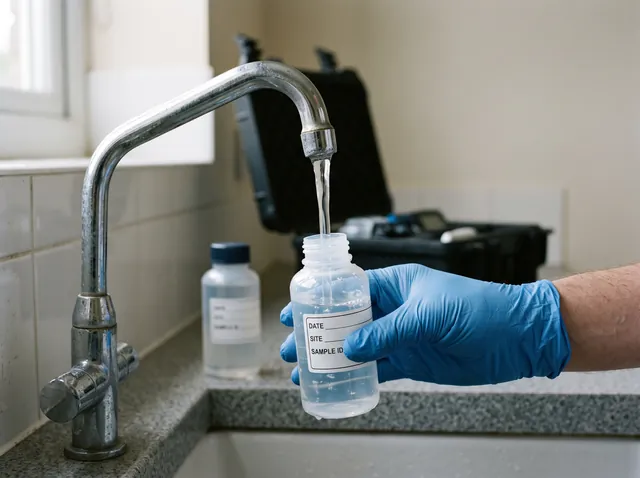
Potable water chlorination is the controlled disinfection of a water system that supplies water intended for human consumption. A chlorine based solution is dosed into the system at a measured concentration, held for a set contact time, then neutralised and flushed out. Samples are analysed at a laboratory to confirm the system is fit to supply drinking water.
Potable covers far more than the kitchen tap. It takes in every outlet used for drinking, food preparation and hand washing, plus the storage tank, the water heater and the pipework between. The point is evidence as much as cleanliness. For a contractor locally, see our chlorination services in Brentford.
Why potable water systems are chlorinated
Water arrives clean at the boundary. It does not stay clean inside a warm, dark, undisturbed network of pipes.
- Legionella Colonises systems held between roughly 20°C and 45°C. The risk is inhaled aerosol from showers.
- E. coli and coliforms Indicator organisms. Finding them points to contamination somewhere in the system.
- Pseudomonas aeruginosa Thrives at outlets, in tap components and flexible hoses. Critical in healthcare settings.
- Biofilm A slime layer on pipe and tank walls that shelters bacteria from flushing alone.
- Construction debris Swarf, dust, jointing compound and flux left behind during installation, all of it bacterial food.
- Stagnation Dead legs, low use outlets and empty buildings let water stand still.
Chlorination is a reset, not a maintenance regime, so it sits alongside temperature monitoring and periodic sampling. See Legionella testing and water sampling.
The legal framework for drinking water in a building
There is no single drinking water law for buildings. The obligations come from several places at once: the Water Supply (Water Fittings) Regulations 1999, general health and safety law supported by the Approved Code of Practice known as ACOP L8, and the standard BS8558.
| Instrument | Status | What it means |
|---|---|---|
| Water Supply (Water Fittings) Regulations 1999 | Legislation | Fittings must not contaminate or waste water supplied by the undertaker, and some installations must be notified first. |
| Health and Safety at Work etc. Act 1974 and COSHH 2002 | Legislation | The actual legal duties. Legionella bacteria are a substance hazardous to health under COSHH, which makes a risk assessment compulsory. |
| ACOP L8, fourth edition 2013 | Approved Code of Practice, not legislation | Special legal status. If prosecuted and shown not to have followed it, you must prove you complied another way or a court will find you at fault. |
| BS8558 and HSG274 Part 2 | Guidance | The practical method for flushing, disinfecting, testing and maintaining water services in a building. |
The duty holder is whoever controls the premises in connection with work, so where a landlord retains maintenance responsibility the duty is the landlord's. A duty owed to non employees cannot be contracted away.
Is water safe to drink after chlorination?
Yes, once the system has been flushed, sampled and cleared. A system is never handed back with the disinfection solution still in it. After the contact period the chlorine is neutralised and the system flushed until residuals return to normal supply levels, and it is signed off only when laboratory results confirm the water meets potable standards.
The concentration used during disinfection is far higher than anything acceptable for drinking, which is why outlets are locked off while the solution is in the system. Residual chlorine is then checked around the building, not only at the dosing point, and flushing continues until readings match the incoming supply.
Our potable water chlorination process
The sequence follows BS8558 and the BS EN 806 series. Each stage exists because skipping it undermines the next.
- Survey We confirm what is treated and locate storage, dead legs, dosing and sampling points, and a safe discharge route.
- Isolate The section is cut off from anything in service, backflow protection confirmed, outlets locked off.
- Flush Debris and standing water are cleared, because they otherwise consume the disinfectant before it reaches the far end.
- Dose The system is filled at the concentration the standard sets for the contact time in use.
- Hold and monitor Free chlorine is measured at outlets around the building. A drop at a far outlet means the dose has not reached it.
- Neutralise The disinfectant is neutralised and the system flushed until residual chlorine returns to the acceptable range.
- Sample Samples are taken from the incoming supply, the tank and representative outlets, then sent to a UKAS accredited laboratory.
- Analyse Testing covers total viable counts, coliforms and E. coli, adding Pseudomonas or Legionella where the risk assessment requires.
- Certify Once results are satisfactory the certificate and records are issued. Where one fails we investigate, re treat and resample.
Time on site runs from part of a day to a full day, driven by system size and how much of the building stays in use. The certificate follows the laboratory rather than the van, because analysis needs incubation time.
Sectors with the highest obligation
Every building carries a duty. In these settings the consequences are more severe and records are examined more often.
- Care homes Residents are older and often unwell, the group most vulnerable to waterborne infection.
- Healthcare premises Patients may be immunocompromised, and augmented care adds Pseudomonas obligations.
- Schools and universities Large systems, many outlets, and long holiday shutdowns that leave water standing.
- Food and beverage premises Water is an ingredient, so the supply must be demonstrably fit for use.
- Hotels Guest rooms sit unused for days, and showers generate aerosol.
- Public buildings Leisure centres, libraries and council offices serve a broad public and face audit.
When is potable water chlorination needed?
Disinfection is needed whenever a drinking water system has been newly installed, opened up, left standing, or has failed a water sample. That means five triggers: commissioning, alteration or repair, recommissioning after a shutdown, a failed microbiological result, and planned intervals set by your risk assessment.
- A new system Never hand over without disinfection, sampling and certification. See new water system chlorination.
- After alteration or repair Replacing pipe, adding outlets or opening the tank exposes the system, so the altered pipework and what it feeds are treated.
- Recommissioning Refurbishments, closures and vacant floors leave water standing. The longer the standstill, the stronger the case.
- After a failed sample A positive result for coliforms, E. coli or Legionella leads to disinfection as remedial work, then resampling.
- Planned maintenance Where the risk assessment sets an interval, often alongside an annual tank clean, the work is recorded.
The documentation you receive
The paperwork is what an inspector, insurer or managing agent asks to see, sometimes years later.
- Chlorination certificate The system treated, the date, the method, the concentration and contact time achieved, and the results. See our guide to the chlorination certificate.
- Laboratory report Results from a UKAS accredited laboratory, showing sample points and analyses carried out.
- Method statement A written record of how the disinfection was carried out, so it can be repeated.
- COSHH information The chemicals used and their safe handling, for anyone assessing the works.
- Site notes Anything found that affects water safety, such as a dead leg or ill fitting tank lid.
Keep it in the water safety file with the risk assessment and monitoring records. A certificate that cannot be found when asked for is, in practice, a certificate that does not exist.
Frequently asked questions
How long does potable water chlorination take?
Half a day to a full day on site for most buildings, depending on system size and the contact time used. The certificate follows the laboratory analysis, which normally adds one to three working days.
Do I need a certificate after chlorination?
Yes, in nearly all cases. The certificate is evidence that the system was disinfected properly and independently tested. Building control, water undertakers, insurers and managing agents all ask to see one.
Can the building stay in use during the work?
Not the part being treated. Water cannot be drawn while the solution is in the system, so those outlets are isolated for the duration. Larger buildings are treated in sections, or out of hours.
What happens if a water sample fails?
The system is not certified. We investigate the cause, often a dead leg, a contaminated tank or an outlet the solution did not reach, then re treat that part and resample. Resampling without finding the cause repeats the failure.
Arrange potable water chlorination
We carry out potable water chlorination across Brentford, the surrounding boroughs and the wider London area, residential and commercial. Work follows BS8558, sample analysis goes to a UKAS accredited laboratory, and the certificate is issued on completion.
Call 020 4532 7773, or arrange chlorination using the enquiry form. For the full range of disinfection work, see our chlorination services in London.
Need your drinking water system disinfected and certified?
Tell us the building, the system and the date the certificate is needed by.